Reduction to modularity, vibe-coded
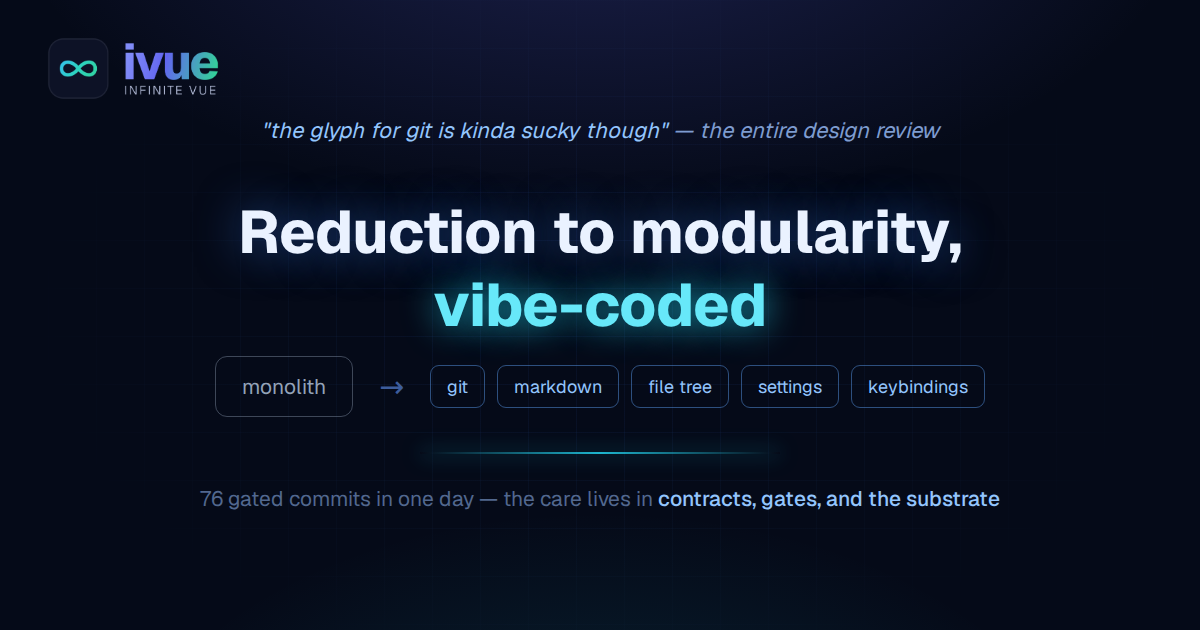
Modularizing a working application is the kind of refactor that is usually done meticulously, by senior humans, over a quarter: draw the boundaries, argue about them in design review, migrate one subsystem at a time, hold the line in code review forever after.
On July 26, 2026, the Invar editor went through that entire arc in one day — 76 commits on main, every one behind a mechanical merge gate — and the human directing it was, in his own words, vibe coding it. Messages like "the glyph for git is kinda sucky though" and "browsing commits is not fun and doesnt work properly" went in; gated, invariant-recorded architecture came out.
What landed, in order:
- Workspace became a pure canvas. Git state, diff state, and markdown left the host. 43 scattered mode checks collapsed into 2 capability questions.
grep -icE "diff|markdown"over the host returns 0, and a boundary check in the gate fails any commit where host code names a plugin. - The plugin kinds got named — and the taxonomy was tested against every existing citizen before it was trusted. Contributors push registrations into the canvas. Providers answer typed questions. Hosted runtimes exchange an owned stream with one reactive owner. One authority per boundary contract, with recorded impossibilities: a provider cannot paint; a contributor cannot answer position queries; a runtime cannot touch the reactive graph directly.
- The file tree became a plugin — after the reduction forced an honest split: document opening is host furniture (Quick Open, tabs, and navigation never consulted the tree), the tree view is a contributor. A zero-plugin build has no sidebar and that is now a literal, recorded claim rather than a slogan.
- Plugins got their own settings and keybindings. Not a manifest file format — typed registrations on the existing contribution context. Plugin bindings form a registry layer above the host floor and below user rebinds; a plugin that tries to register a reserved chord is refused at registration. The acceptance test overshot: the count of source-control lines in the host keybinding table went from 13 to 0.
- Keyboard ownership got its invariant: the focused surface owns the keystroke; the host claims a minimal reserved set, each chord carrying a written warrant. Every F-key was retired for modifier chords — and every replacement was proven to arrive through a real PTY on both terminal parser generations, because measuring the codebase's own claims found three of them false, including the one the whole F-key design had rested on.
The same day also produced structural code folding (folding and word wrap now contribute to one shared line-to-row generator, because two mappings consulted by different consumers will disagree), inline AI rewrites through a swappable provider port, two operating-system-level root causes in the PTY layer, and a machine-wide scheduling lock that turned a fog of "flaky tests" into a two-way classifier: load flakes versus real intermittent defects with nowhere left to hide.
The trick is that there is no trick
Nothing about the model changed at midnight. What made casual direction produce architecture-grade output is that the meticulousness humans usually supply by vigilance had been moved into the substrate, in three layers.
The invariant contracts are the design review. The repository carries 32 recorded invariants, each with a scope, a mechanism, and — the load-bearing part — an impossible-if-true list. "A claim may not derive its occupancy from the aggregate it feeds" exists because an extraction produced a boot-time cycle once; now every later extraction is checked against it mechanically. A human architect applies such rules by remembering them in review. Here, forgetting is not an available failure mode.
The gate converts vibes into evidence. Every landing runs the type checker, 1,500+ unit tests, ~60 driven PTY smokes that operate the real program through a real terminal, a plugin-boundary scan, a coverage ratchet that refuses undeclared assertion loss, and a performance trend detector with a positive control. The human can afford to say "something is nagging the scrolling" precisely because the system demands the fix arrive with paired measurements and a ratchet. Loose input is affordable when output discipline is mechanical.
ivue removes the failure class that punishes speed hardest. The classic modularization killer is the mysterious initialization-order bug — works unless module A loads before module B. The Static() / Reactive() namespace discipline resolves members at call time, not import time, so there is no hidden load order to get wrong; attach order is explicit data in the plugin contracts. The two dependency cycles the extractions did produce failed instantly and loudly — a stack overflow at boot, caught by a smoke, fix site in the trace. The bugs that remain are the debuggable kind. Velocity stops compounding into swamp.
The part the human still does
Reading that day's transcript, the human's contribution is not carefulness — it is judgment at the reduction points. Deciding that document-opening is host furniture but the tree view is not. Deciding the capsule vision waits until the architecture is refined, but its simple core (per-workspace agents that resume their sessions) folds into the extraction. Vetoing a glyph. Noticing that browsing commits "is not fun."
Everything below that judgment line — the boundary enforcement, the proof that a chord actually arrives, the check that a hover doesn't paint one row too low, the discipline of never landing on a red without proving the red pre-existed — is structure. And structure, unlike vigilance, doesn't get tired at 4 a.m., which is incidentally when several of these landings happened.
That is the actual demonstration. Not that an AI can write a lot of code — that is old news. That reduction to modularity, the most meticulous work in software, survives being directed casually when the care lives in contracts, gates, and a substrate that makes carelessness fail loudly instead of mysteriously.
The greps are in the repo. Run them.