
What JavaScript becomes
Two articles on this blog prove two properties. Circular imports, dissolved shows a 371-file codebase whose value-import graph measures zero cycles while its domain stays fully cyclic. Module-level state is a bug shows the same codebase running on zero module-level declarations, its every long-lived value owned by a class.
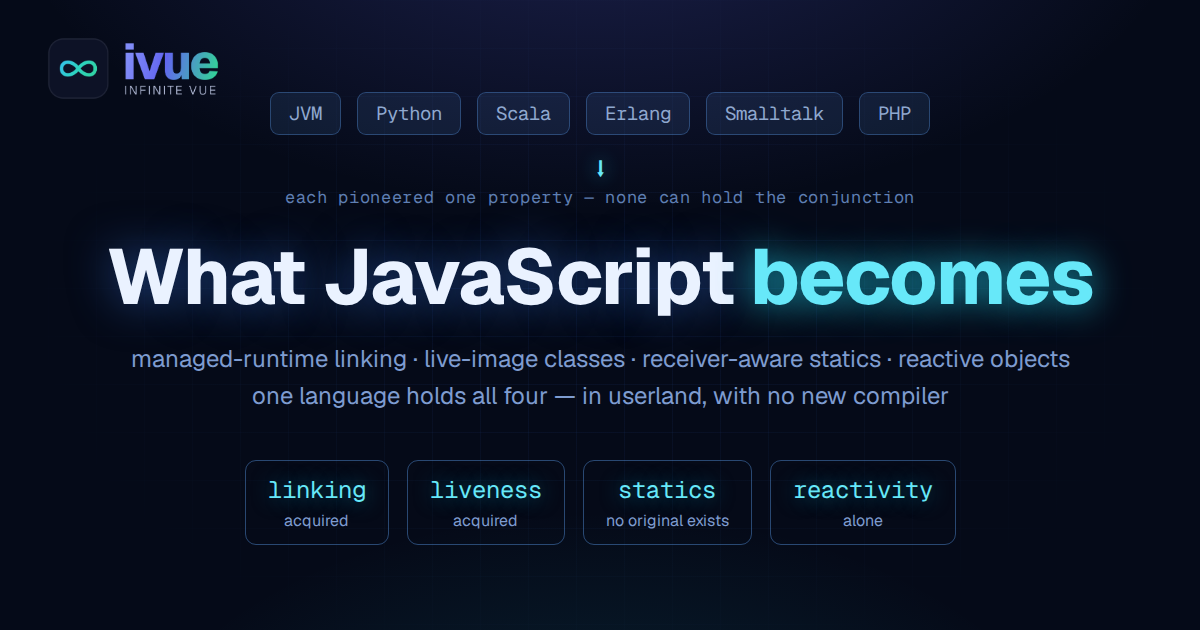
This article asks what those properties add up to — because the answer is not "JavaScript, tidied." Put the discipline's pieces side by side with the languages that pioneered each one, and a stranger claim comes into focus:
Each capability exists somewhere — in the JVM, in Erlang, in Scala, in Smalltalk. The conjunction exists nowhere else. And nowhere else can it be added without a new compiler.
Language by language, then.
Java and C#: the linking model, acquired — then passed
Java never had an import-cycle problem. Not because Java engineers were disciplined, but because a Java class is a declaration, not a script. The JVM loads classes lazily and runs a class's initialization at its first active use — order emerges from demand. A JavaScript module is the opposite kind of thing: a program that executes when loaded, in an order the loader must choose. Everything painful about cycles follows from that one difference.
The namespace pattern converts JavaScript modules into declaration-like units. The import pulls in a symbol table; every cross-module evaluation waits for first touch. That is the JVM's linking model, acquired as a usage convention — no classloader required.
Then JavaScript passes them. Neither Java nor C# has late static binding: a static member resolves against the class named at the call site, period — override a static in a subclass and dispatch does not follow the receiver. PHP found this painful enough that it added the static:: keyword in 5.3 just to get receiver-following statics. JavaScript has had them natively forever — this inside a static method is the receiving class — and Static() turns that from a curiosity into a storage system: $-cached getters materialize per receiver, so every subclass owns its own lazily-built copy of the static state. A statically-compiled language cannot express this; its static references are burned in at compile time.
Python: the same wound, treated per symptom
Python is the honest comparison, because Python has JavaScript's exact disease: a module is an executed script, cycles meet half-initialized modules, and programs crash on AttributeError: partially initialized module. Python's official remedy is to move the import statement inside the function that needs it — deferring the reference to call time.
Look closely: that is the same medicine the namespace pattern prescribes — access-time resolution. The difference is the regimen. Python applies it per crash site, after the crash, as a documented exception to normal style. The namespace pattern applies it to every cross-module reference, before any crash, as the normal style itself. One language takes the cure symptom by symptom; the other is immunized.
Scala and Kotlin: the lazy object, extended
Scala's object and Kotlin's by lazy are the closest relatives of the $-cached static getter: singletons initialized on first touch, by language design. If the discipline stopped there, this section would read "JavaScript catches up to Scala."
It does not stop there. A Scala object is terminal — it is an endpoint of the language, not a member of a hierarchy. Subclasses of a class do not each receive their own copy of companion-object state; there is one object, full stop. The per-receiver cache inverts that: the static storage follows the inheritance tree, materializing separately for each class that reads it. A capability class and its test subclass hold independent tables by construction — which is why the test is a subclass works with no mocking machinery. That storage semantic — lazy singletons, per node of the hierarchy — is not a port of anything. It has no original.
Erlang and Smalltalk: the live image
This is the sleeper. Read the namespace's second line again:
export let Class = Reactive($Class); // let — a LIVE, mutable slotA mutable class slot, resolved at access time is structurally the thing Erlang built a telecom empire on: hot code replacement, where the next call lands in the newest version of the module. It is also Smalltalk's live image, where classes are ordinary objects a running system can rebind. Invar's sealed kernel is this property used deliberately — plugins fold subclasses over the slot before boot, then the kernel freezes — and development itself uses the same property continuously: edit a method, and live instances answer with the new body, state intact.
Java and C# fake pieces of this with bytecode agents and edit-and-continue debuggers — privileged tooling, bolted to the runtime. In JavaScript it is an assignment statement.
The axis with no comparison: reactivity in the object model
Every language above stops at the same line: none of them can make an ordinary object observable without ceremony. C# ships INotifyPropertyChanged — the object must announce its own changes, by hand, property by property. Python's descriptor protocol can host observable attributes (traitlets does), but through base-class ceremony and explicit change publication. In both, observation is something an object must be written for.
JavaScript's object model is interceptable at the property level — getters and prototypes all the way down. That is what lets Reactive() transform a plain class in place — same identity, instances stay plain objects — and hand back a graph where reads subscribe and writes notify, with the class none the wiser. The consequences compound in a way that is easy to miss: the same class graph that solved linking and storage above is also the observation graph. That is why an external process can query any state by dotted path, why one coarse render effect can drive a whole IDE, and why the object graph came back without a performance bill. One structure, three roles.
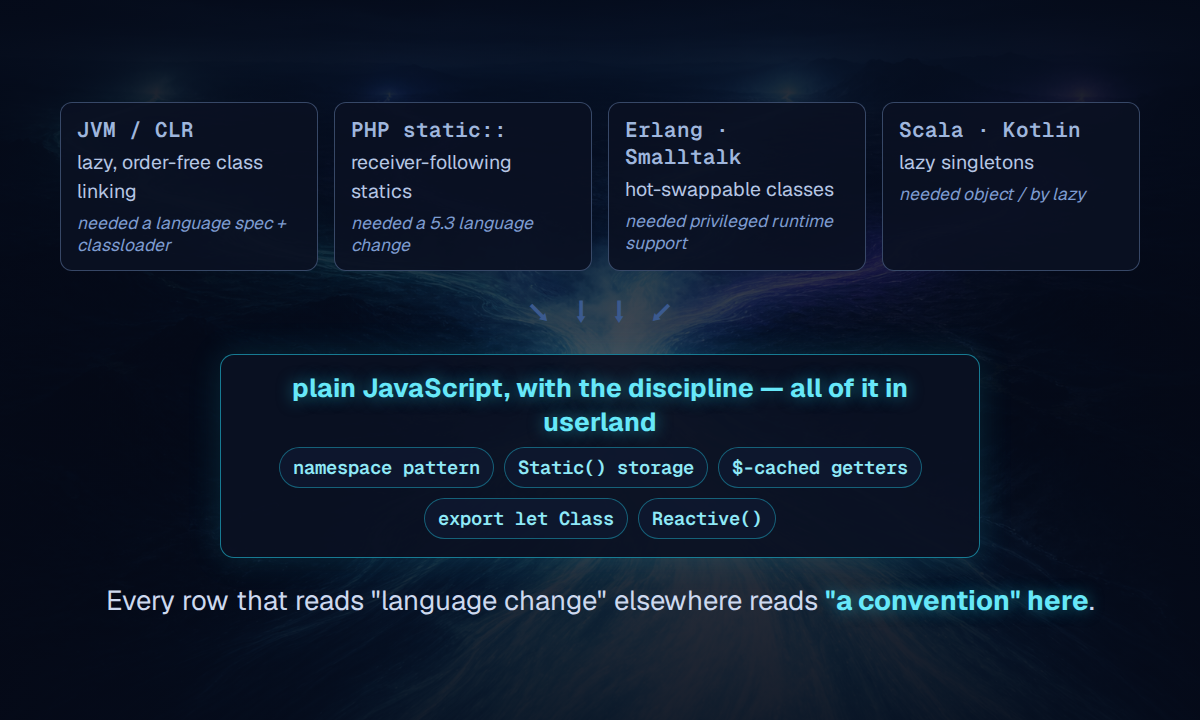
The scorecard
| capability | who pioneered it | how they got it | JavaScript, with the discipline |
|---|---|---|---|
| lazy, order-free class linking | JVM / CLR | language spec + classloader | namespace pattern — a convention |
| receiver-following statics | PHP (static::) | a 5.3 language change | native this, plus Static() storage |
| per-hierarchy lazy static state | — | no original exists | $-cached getters, per receiver |
| hot-swappable classes | Erlang, Smalltalk | privileged runtime support | export let Class — an assignment |
| lazy singletons | Scala, Kotlin | object, by lazy | $-getters — same semantics |
| transparent reactive objects | — | closest: ceremony-based (C#, Python) | Reactive() — in place, identity kept |
Every row that reads "language change" or "runtime support" on the left reads "userland" on the right. That asymmetry is the actual finding:
The properties JavaScript is mocked for — mutable prototypes, getters on anything, dynamic
this, open classes — are exactly the degrees of freedom the discipline is built from. The dynamism was never a weakness. It was unclaimed capability, waiting for a discipline.
And the door does not swing the other way. Java cannot adopt the namespace pattern idiomatically — holding classes in mutable slots means surrendering new, constructor typing, and paying reflection at every site. Scala cannot add per-receiver companion state — objects sit outside dispatch. Each of those languages would need a language change to acquire what JavaScript acquires with an export shape and a getter convention. Meanwhile the discipline is enforceable today, mechanically: Invar gates every one of these conventions with AST censuses — a stricter dialect of JavaScript, run without forking the language, measured at zero continuously.
A conjunction, not a coronation
This claims a combination of properties — Java keeps its type system, Erlang keeps its concurrency, and a discipline only holds where it is enforced, which is why the gates are part of the result. With the scope set, the sentence stands: the scripting language everyone mocked ends up as the only mainstream language holding managed-runtime linking, live-image classes, receiver-aware static storage, and transparent reactive objects at once — and it holds them in userland. The languages that pioneered each property cannot reach the conjunction. The language with no compiler, no linker, and no blessed runtime walks into it — carried by one kilobyte of discipline.
That is what JavaScript becomes. It was always allowed to. It was just never asked.

Comments