The brick, the editor, and the referee
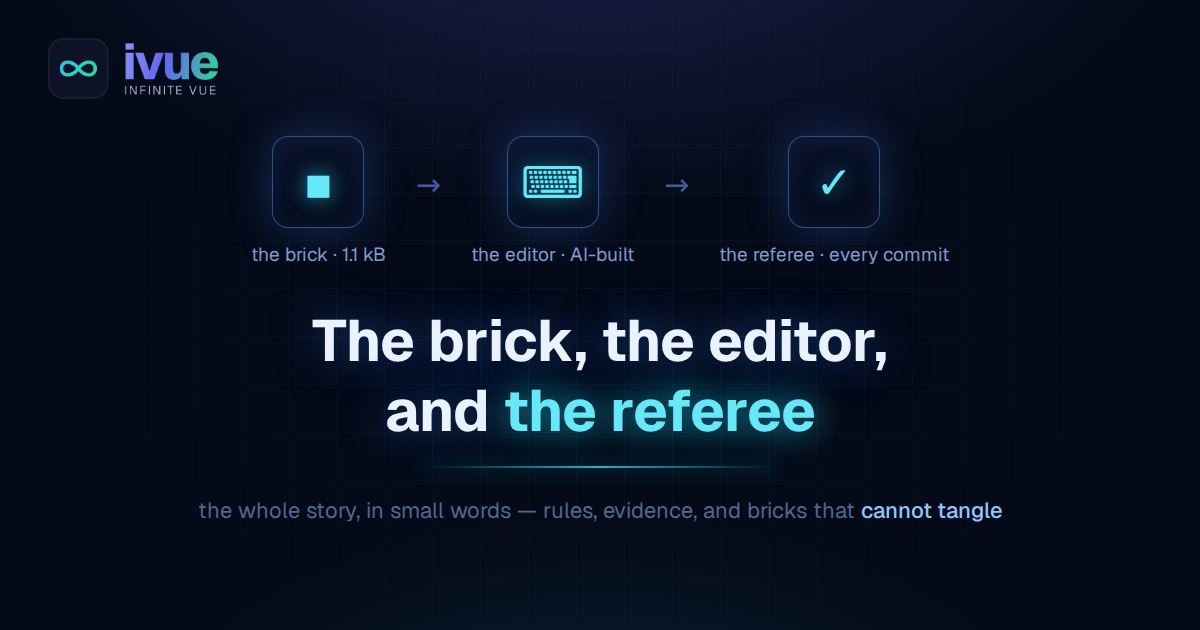
Most posts on this blog argue. This one just tells the story, in the smallest words we can find — because when we stepped back and looked at what had actually happened, the simple version turned out to be the honest one.
1. The brick
Most software is built out of tangled stuff — knots of state, frameworks, and glue. ivue is a brick: about a kilobyte of engine that lets you build out of plain classes that snap together and update themselves when anything changes. And the blocks never tangle — no matter how deep you stack them, no matter which file references which, the connections cannot knot.
That "never tangles" property looks like a convenience. It is the superpower everything below stands on.
2. The editor
To prove the brick, we built something big out of it: Invar, a real code editor that runs in a terminal — file tree, tabs, git panel with side-by-side diffs, language intelligence, an integrated terminal. It is fast, it is small, and it is used daily.
Here is the strange part: AI agents wrote almost all of it. The human's job was to state the rules that must never break — each module carries a written contract of them — and a referee checks every change against those rules by actually driving the editor and reading its screen, before anything is allowed in. Agents built features overnight. The referee rejected what broke the rules. The codebase stayed clean — measurably: zero tangles, one cache, after hundreds of commits.
Rules, plus a referee, plus untangleable bricks. That combination is the discovery.
3. The toy box that builds toys
Then something unplanned happened. An AI coding assistant was run inside the editor's new terminal — and it became obvious that the editor already had every part an AI assistant's home needs: a place to talk, panes to show work in, overlay dialogs for questions, and eyes into the code itself.
So the next blueprint wrote itself, and it rests on one idea: an AI assistant should not be a wall of text you trust. It should be a colleague that shows you — the change as a real diff, the file opened at the real line, the test that proves it, the work happening live as it happens, replayable tomorrow. Reading its work and verifying its work become the same act.
Slop — AI output that merely looks right — survives only where checking is expensive. Make showing cheap and slop loses its habitat.
4. Doors that open both ways
The same blueprint gives the human a door policy. Every action the AI wants to take arrives as a question in data: let reads through automatically, make writes ask, forbid the dangerous things entirely — or require that the referee is happy before a change may even be committed. A second AI can answer the first one's routine questions, so only real judgment reaches a person. Every answer is recorded.
And the doors open the other way too: the AI can use the editor's own eyes and hands — ask the language server what a type really is, look at the actual rendered screen, run the actual tests — to prove its work instead of describing it. The human governs the machine; the machine shows its homework; the referee checks them both.
5. The toy that makes new toys
The last unlock follows from the others. Because the rules and the referee ship inside the box, anyone who has the editor can simply ask it for a new feature — and their AI builds it under the same contracts, checked by the same referee, in the same untangleable bricks. Good pieces can flow back to everyone, carrying their evidence with them: a contribution is reviewable because it arrives with its contract, its test, and its green referee run.
Software that grows by conversation — and cannot drift while growing. The editor is named Invar after the alloy engineered not to expand under heat. The name is the whole thesis.
In one breath
Write down the rules that must never break. Give the rules a referee. Build out of bricks that cannot tangle. Then AI can build almost everything else — fast, in parallel, overnight — and you can watch and check instead of trust. The kilobyte made the editor possible; the editor makes the AI's house possible; and a house with rules, evidence, and a referee is the first one worth letting the machines build in.
The brick is on npm. The editor is on GitHub. The referee runs on every commit.