
What becomes buildable
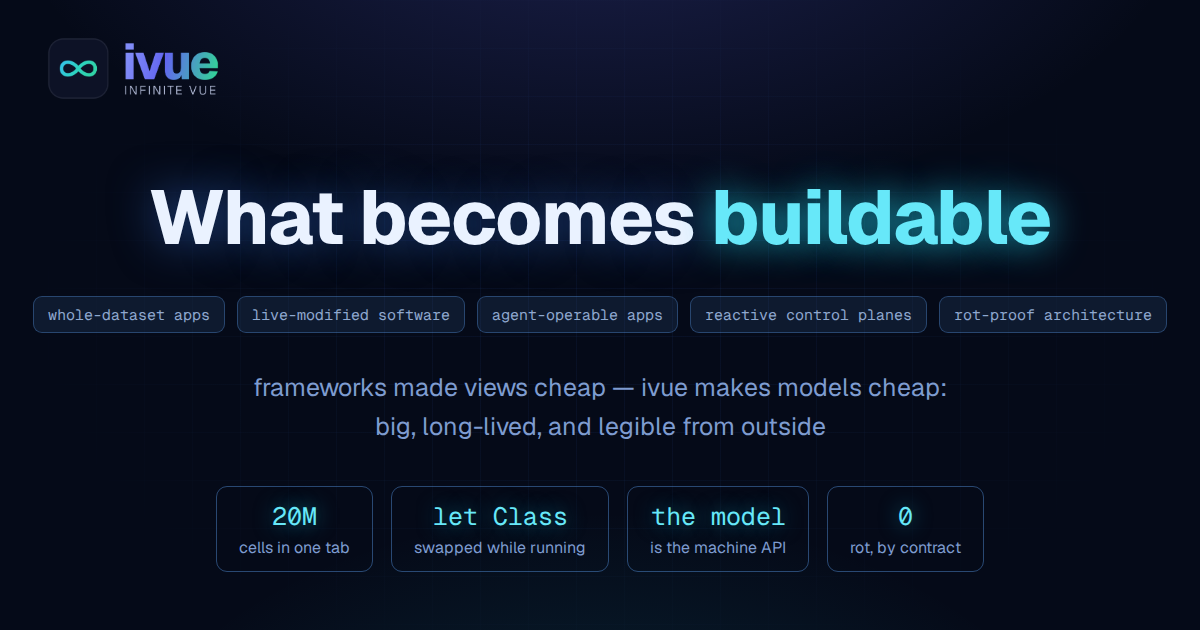
Every framework generation made views cheaper — faster diffing, finer signals, less re-rendering. The model layer never got the same gift: models stayed expensive to make big, tied to component lifetimes, and opaque to everything outside the render loop. A lot of software you'd like to build was never blocked on rendering. It was blocked on models being expensive, mortal, or opaque.
ivue's whole design attacks exactly those three, so it's worth naming what that opens — five categories, each unlocked by a specific property.
1. Whole-dataset applications in the browser
Unlocked by: cost proportional to what's observed.
The intractable thing about a spreadsheet, a gigabyte log explorer, or a genome browser was never painting it — virtual scrolling solved that years ago. It was modeling it: mainstream reactivity charges per entity that exists (a proxy here, a computed there, a subscription each), so a million-row model collapses before first paint, and everyone retreats to server paging and dead snapshots.
ivue charges per entity observed. Derivations are shared prototype getters at zero bytes per instance; state materializes on first touch; the flyweight pattern drops per-cell cost to 4.7 bytes across twenty million live cells. The consequence is an architecture that used to be a joke: the entire dataset is the client-side model, fully reactive. Excel-class spreadsheets. Log viewers over raw gigabytes. Timeline and audio editors. BI tools that pivot the actual data, locally. This one isn't a prediction — the grid and the million-row scroller run on this site.
2. Software that's modified while it runs
Unlocked by: the live class slot and identity-preserving transforms.
export let Class = Reactive($Class); // let — a live, mutable slotThat one keyword is the Smalltalk image made shippable: the next call always lands in the newest version of the class, method edits graft onto live instances with state intact, and implementations swap under a running system. Invar's sealed kernel is the disciplined form — plugins fold subclasses over class slots before boot, then the kernel freezes.
The category this reopens: deeply extensible software. In-app plugin ecosystems with real typed classes instead of stringly config. User-extensible tools at the level Excel macros hinted at. Live A/B of implementations, not just flags. The JS ecosystem gave this up when state got imprisoned inside component scope; objects that outlive everything bring it back.
3. Agent-operable software, by construction
Unlocked by: the legible object graph.
Making software drivable by machines has always meant one of two bad options: screen-scraping (brittle) or hand-building an automation API that forever lags the UI (expensive). An ivue application's model is the API:
workspaceSet.active.editor.selectLine(42)One navigable graph — the one the ecosystem abandoned — path-addressable, with no publish tax, the same state the UI renders. Invar runs on this today: agents drive it, verify their own work against it, and its test oracle is the model itself.
Apps born with their machine interface. The copilot reads and writes the exact state the user is looking at, automation stops breaking on redesigns, and every app is one adapter away from being an MCP server.
Software that wants agents inside it — which is rapidly becoming all software — currently pays a second-API tax to get there. Here the interface falls out of the architecture.
4. Reactive control planes
Unlocked by: observation-owned resources.
In Invar's backend, database connections, language-server processes, and timers exist only while something observes them — reactivity working as the allocator, with a pull floor underneath for correctness. Generalize that and you get a systems discipline: process supervisors, dev-tool daemons, home-automation and fleet dashboards where "what should be running" is derived state instead of imperative choreography.
This is Erlang's supervision insight expressed in TypeScript, with a reactive graph as the supervisor. It was intractable for a plain reason: backend code never had a reactivity substrate, and frontend reactivity was never trusted near file descriptors. Both halves of that objection are now dead in one codebase.
5. Architecture that cannot rot
Unlocked by: the invariants layer — contracts, censuses, gates.
Any codebase touched by enough hands erodes. Review vigilance stops scaling at some contributor count; "the architecture" degrades into a wiki page nobody obeys. The discipline built around ivue turns architecture into something executable: invariant contracts stating what must hold, AST censuses counting violations, merge gates that reject what the model contradicts — uniformity as a measuring instrument, zeros that hold while the codebase triples.
What that opens is a contributor scale that used to be self-defeating: agent fleets as a normal construction method, teams where the structure carries the care instead of the reviewers, software in regulated domains whose properties are proven continuously rather than audited annually. This is the multiplier on the other four — big, live, legible models are only safe to build by many hands when the discipline is mechanical.
The shape of it
One sentence version: frameworks made views cheap; ivue makes models cheap — big models, long-lived models, externally legible models — and each category above is a product family that was blocked on exactly one of those costs. One more we suspect but haven't proven: local-first sync should get simpler on identity-stable plain objects, where CRDT merging never fights a proxy for object identity — a hypothesis waiting for its builder.
The substrate is 1.1 kB, the Standard teaches it to your team and your agents in one document, and the proof-of-scale runs a full IDE. Pick a door.

Comments