
Reactivity is an allocator
Ask the industry what reactivity is for and the answer is unanimous: keeping the screen in sync with the data. Signals, stores, virtual DOMs — the entire apparatus points at pixels.
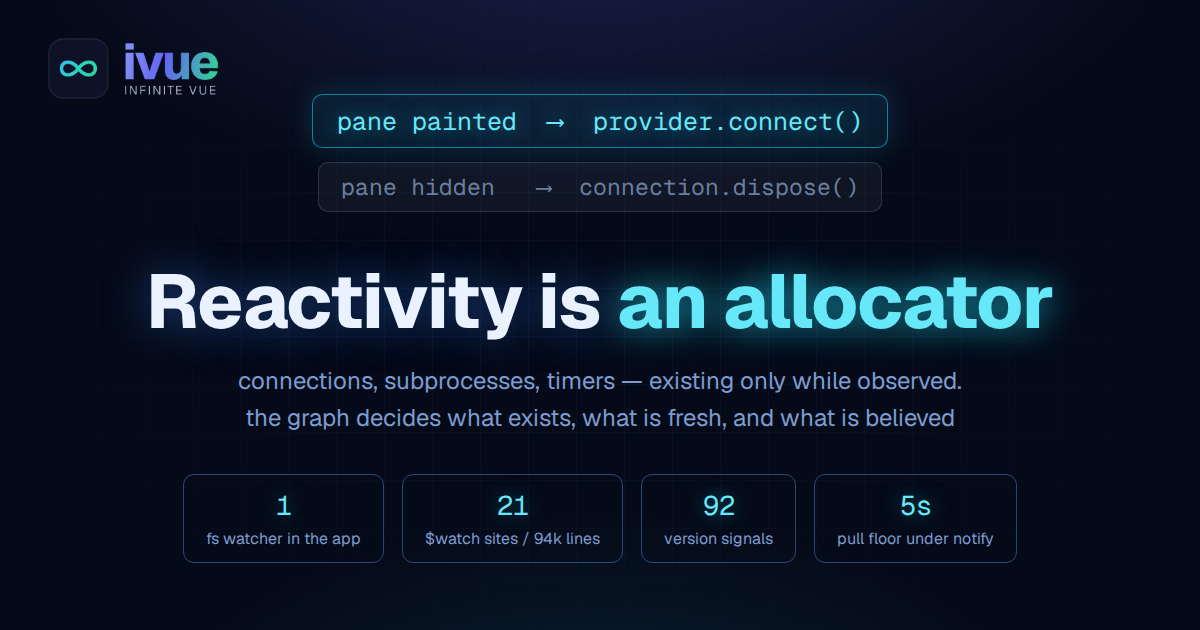
Here is a different use. In Invar, whether a SQLite database connection exists is decided by two refs — the dock panel's visibility and its active tab:
isPainted: () => activeHost.visible.value
&& activeHost.activeContent?.id === contribution.content.id,Open the database pane and a connection materializes. Switch tabs and it is disposed — not hidden, not pooled: closed. The same regime governs git subprocesses, language-server processes, sampling timers, and animation heartbeats across the codebase. Reactivity is not painting this application. It is allocating it.
The inversion: the OS layer is not reactive
The naive version of "reactive backend" wraps the file system in refs — every path a signal, every directory listing observable. Invar does the opposite, and the opposite is the finding:
The Files capability class — the single home of every file system call — holds zero refs and zero state. The git file watcher owns FSWatcher handles and timers and never touches a ref. The PTY layer dlopens libc for raw file-descriptor work — reads, writes, ioctl — with no reactivity anywhere in sight. The operating-system boundary is imperative, synchronous, and plain.
Reactivity is not the plumbing here. It is the government. Ground truth stays imperative at the bottom; the reactive graph decides, from above, what exists, what is fresh, and what is believed.
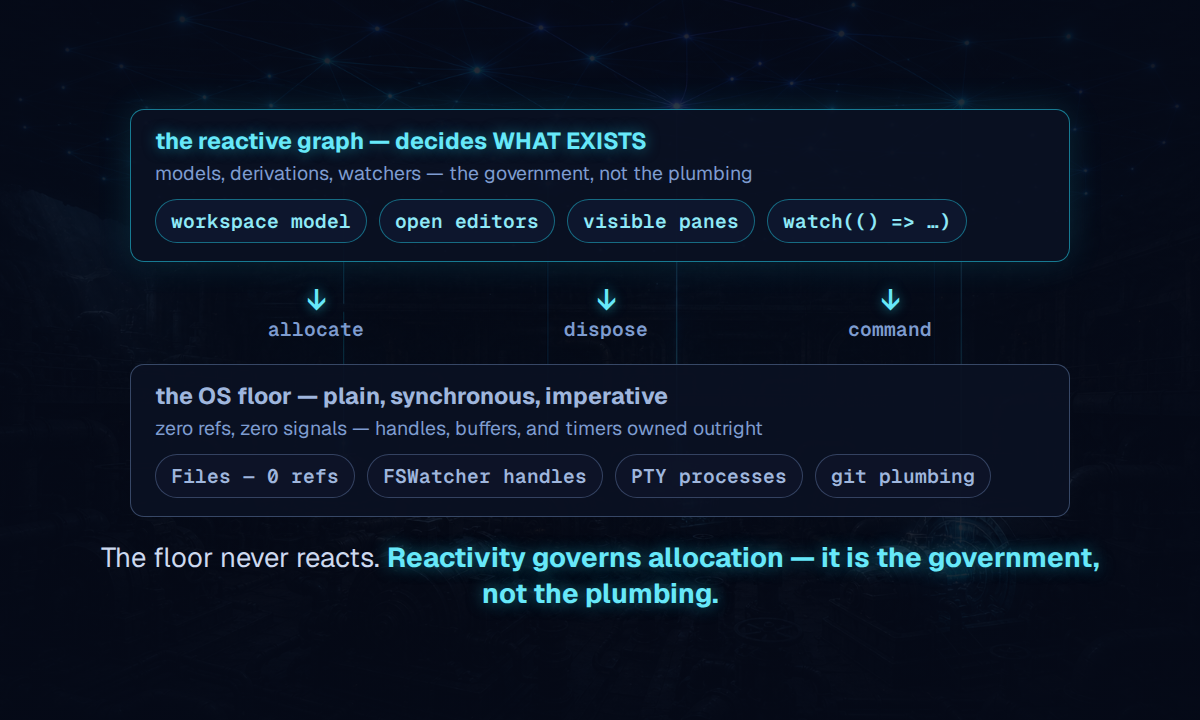
Those three decisions — exists, fresh, believed — are three idioms, and every backend module composes the same three.
Idiom one: the revision bridge — what is fresh
The project contract states it flatly: ground truth is compact and non-reactive at rest — plain Maps, Sets, typed arrays. Refs are sparse version signals, not value holders. The bridge from OS-land into the graph is one move, used everywhere:
// The imperative owner mutates plain ground truth, then bumps ONE
// counter. Reactive getters subscribe with a read they discard:
get diagnosticCount(): number {
  void this.diagnosticsRevision.value; // subscribe — value unused
  let count = 0;
  for (const batch of this.diagnosticBatches.values()) {
    count += batch.items.length;
  }
  return count;
}Counted across Invar's source (2026-08-11): 92 revision-bump sites and 19 of those void …Revision.value subscribe prologues. No diagnostic is a ref. No terminal cell is a ref. No blame line is a ref. The graph tracks that something changed; the values stay in structures sized for the data.
The worked example is the blame cache. Showing "who last touched this line" in the status bar has a brutal constraint: a cursor move must be instant, but git blame is a subprocess. The resolution is that the disk already publishes a version signal — the file's modification time — and the cache subscribes to it by stat:
lineBlame(documentPath: string, lineNumber: number): BlameLine | null {
  void this.revision.value;                          // reactive subscribe
  const mtimeMs = this.statMemoizedMtime(documentPath); // ≤ 1 stat / 30 ms
  const cached = this.cache.get(documentPath);
  if (cached && cached.mtimeMs === mtimeMs) {
    return cached.lines.get(lineNumber + 1) ?? null; // pure cache hit
  }
  void this.loadBlame(documentPath, mtimeMs);        // fire-and-forget spawn
  return null;
}A save bumps the mtime, so the cache invalidates exactly when the file changes on disk; a cursor move is a pure hit. Sixteen files at most, least-recently-used out; an unblamable file caches an empty map at that mtime, so the negative answer never re-spawns per frame. One subprocess per file per change — reactivity decides when the answer is stale, the OS's own metadata says so, and nothing polls.
Idiom two: observation owns the resource — what exists
The database pane from the opening, in full:
constructor(
  protected readonly workspace: Workspace.Model,
  protected readonly isObserved: () => boolean, // bottoms out in two refs
) {
  this.$watch(
    () => this.isObserved(),
    (isObserved) => this.observationChanged(isObserved),
    { immediate: true },
  );
}

observationChanged(isObserved: boolean): void {
  if (isObserved) {
    void this.refresh();          // connect, describe, publish
  } else {
    this.invalidateRequests();    // stamp every in-flight answer stale
    this.releaseConnection();     // the OS resource is CLOSED
  }
}The same shape runs the monitoring pane (its sampling setInterval exists only while the pane is painted — the contract is titled "the monitor names its own cost and pays it only when observed", and the cheap reading is measured at 0.17–0.24 ms against a gated 5 ms budget) and the tasks dashboard, which sharpens it further: its 60 fps animation heartbeat requires not just a visible pane but a spinner inside the painted window. Five hundred tasks with one visible spinner cost one timer. Zero visible spinners cost none.
A hidden pane owns no timer. A closed dock owns no connection. An unopened terminal owns no file descriptor. Cost tracks the observed set — not the feature set.
Lifecycle hooks could approximate this, and every framework has them. The difference is that a lifecycle hook fires on component events; the predicate here is composed state — visibility AND active tab AND painted window AND content that moves — and it reacts when any input changes, because it is just a tracked read. You cannot forget to handle a transition; there is no list of transitions to handle.
Idiom three: the late answer — what is believed
Every backend result is asynchronous, and the project contract names the danger precisely: an async result can outlive the state it described. The pane that requested a connection may be hidden by the time the connection opens. The discipline: stamp every request with a generation, and guard the write, not the call:
const connection = await provider.connect({ identifier, filePath });
const descriptions = await connection.describe(null);
if (
  generation !== this.refreshGeneration ||   // a newer request superseded us
  !this.isObserved() ||                      // the pane hid mid-flight
  this.providers.resolve('database') !== provider // the plugin hot-swapped
) {
  connection.dispose(); // the connection that JUST OPENED is closed, unpublished
  return;
}
this.connection = connection;Three independent staleness axes — request generation, observation, provider identity — and the failure mode each prevents is real: a connection published to a hidden pane leaks; a slow old answer overwriting a fast new one lies. The git status refresher re-checks its request id four times (after the subprocess, after parsing, in the catch, in the finally); every LSP semantic request captures the document revision before its await and discards the reply on mismatch. Stale answers are not errors — they are simply never believed.
The floor: a notify channel cannot report its own silence
Now the part that looks backwards until it clicks. This entire IDE — file tree, editors, git panel, watchers — contains exactly one file system watcher, and it belongs to git. No chokidar, no recursive watch, no watcher per open file.
The reason is an invariant with teeth: a notify channel cannot report its own silence. A watcher that goes quiet is indistinguishable from a file system where nothing changed — silence carries no signature. So no notify channel is ever trusted alone:
Notify is a latency accelerator over a pull floor — never a replacement for it. Correctness comes from periodically re-reading ground truth; events only make the common case fast.
The git watcher embodies the whole doctrine. Its events collapse into one debounced refresh (80 ms) whose payloads are ignored — no correctness rides on which file an event names. Under it, a reconcile floor re-runs git status every five seconds regardless. Every error path — a failed walk, a dead handle, an unstatable directory — fails toward a refresh. And the invariant is validated across an unrelated domain: Invar's own build fleet once had a worker hang for ninety minutes, silently, under notify-only orchestration — the pull heartbeat that caught it is the same rule wearing different clothes.
One prerequisite makes a five-second poll livable in an app whose renderer sleeps between changes: the poll compares before it writes. An unchanged git status writes zero refs — field-compared, deliberately — so the floor never wakes a quiescent render loop. Polling for correctness, silence for the graph. That one compare is why "pull floor" and "demand-driven rendering" can coexist at all.
The tally
Add it up and the numbers inverted from what "reactive backend" suggests (counted 2026-08-11, non-test source):
fs watchers in the application:      1   (git — with a 5 s pull floor)
$watch / $watchEffect sites:        23   (in 107,670 lines, re-counted 2026-09-03)
revision-bump sites:                92
void-revision subscribe prologues:  19
isObserved sites: 29Twenty-three watch sites in a hundred and eight thousand lines — because push is reserved for the places a state change must drive an action: a resource opening, a document syncing to a language server, a timer dying. Everything else is pull — tracked getters, read by one coarse frame effect, asleep until a signal moves. And all of it runs on the same 1.1 kB engine the browser examples use, under Bun, with no Vue component in sight — the classes, the refs, and the watch semantics are the whole runtime.
Not "wrap the backend in refs"
The inversion deserves its warning label: naive reactivity at the OS boundary — a ref per path, a watcher per file — buys memory churn, event storms, and untrustworthy silence. The discipline is precisely the three idioms plus the floor, and the coarse signals are load-bearing: this works because the graph is sparse.
What survives is the reframe. Reactivity was never really about pixels — it is a machine for keeping derived state consistent with ground truth. "This pane's pixels" were merely the first derived state anyone pointed it at. Whether this connection should exist is derived state. Whether this cache is fresh is derived state. Whether this answer is still true is derived state. Point the machine at the operating system, and it allocates, schedules, and disbelieves — with the same refs and the same watch it uses to move a cursor.
Rendering was just reactivity's first job.

Comments