
The test is a subclass
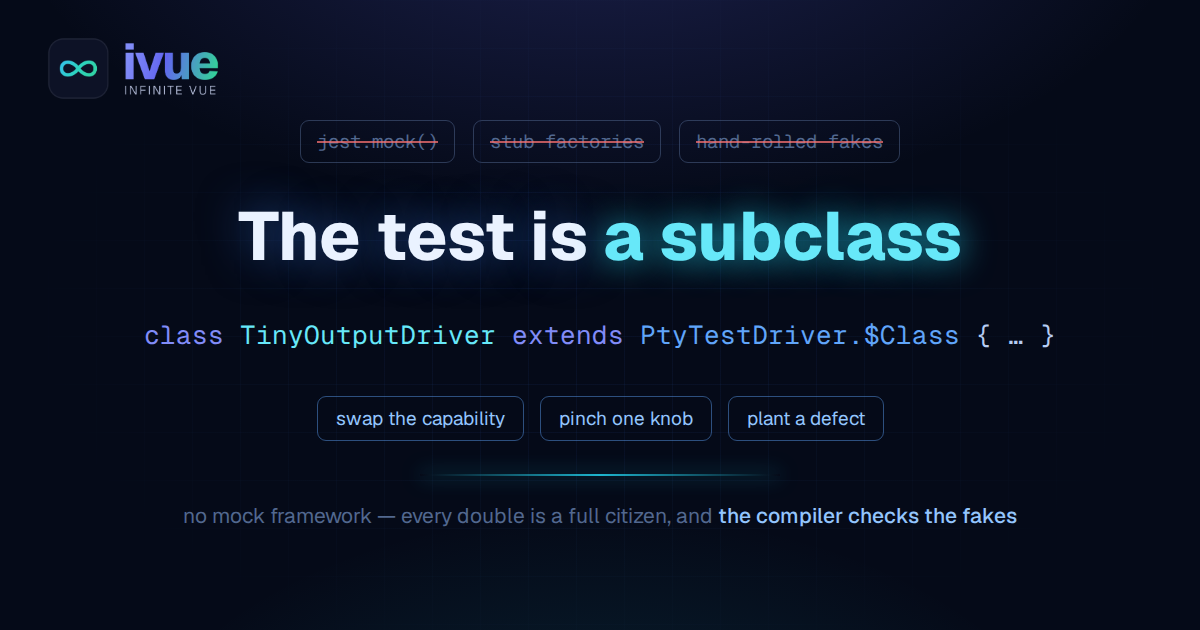
There is no mock framework anywhere in Invar's test infrastructure. No jest.mock, no stub factories, no hand-rolled objects pretending to be interfaces. And yet the harness routinely runs the editor against a fake language server, measures the inside of a popup from outside the process, and proves that its own checks can fail.
It does all of this with the two exports every ivue namespace already has: Class and $Class. The pattern shows up in three strengths.
Strength one: swap the whole capability
Every ivue namespace is a seam. When a smoke needs the completion popup to face exactly 5,000 deterministic items instead of a live language server, it doesn't mock the client — it preloads a file that substitutes the provider at the seam the product already asks:
// completion-mock-provider-preload.ts (abridged)
class $MockLanguageProvider extends LanguageClient.$Class {
  override async completion(
    document: TextDocumentModel,
    position: TextPosition,
    context: LanguageCompletionContext,
  ): Promise<LanguageCompletionList> {
    return this.deterministicItems; // 10, 1,000, or 5,000 of them
  }
}The product never learns. It asks the namespace, the namespace answers with the substitute, and — this is the part a mock framework can't give you — the substitute is a full citizen, type-checked against the same contract as the real thing. When the LanguageProvider interface grew a field last week, the mock failed to compile until it was honest again. Stub drift, the slow death of every mocked test suite, is a compile error here.
The same move appears wherever a boundary needs a controlled far side: a mock RewriteProvider stands in for a live AI model in the inline-rewrite smoke; a mock TTS engine stands in for audio in the voice-picker smoke. One pattern, no framework.
Strength two: subclass to pinch one knob
Sometimes the test doesn't want a different capability — it wants the real one with a single parameter made small enough to observe. The PTY driver caps how much terminal output it retains, and that bound needs testing without generating megabytes:
// PtyTestDriver.test.ts
class TinyOutputPtyTestDriver extends PtyTestDriver.$Class {
  protected static override get retainedOutputLengthLimit(): number {
    return 96;
  }
}That is the entire test double. Every code path is the production path; one protected getter is pinched. The $Class export makes this a designed affordance rather than a hack — the raw class is published by the namespace precisely so that extension is first-class. The same trick instruments hot paths from outside: a measured subclass of the popup overrides recomputeMatches(), calls super, and publishes a counter — which is how the harness proved, through a real terminal, that selection in a 5,000-item list does zero refiltering.
Strength three: subclass to plant a defect
The harness's rule for its own checks: a check that can only fail toward "pass" is a decoration. Every detector must be shown its quarry at least once. So the width-agreement check feeds itself 漢 and requires the answer 2. The coverage ratchet has a fixture file whose only purpose is to be caught. The quiet-lock test constructs a holder that never releases and requires the degrade warning to name it. The machinery for most of these positive controls is the same subclass move — take the real class, override one member to be defective, require red.
This is the strength most test suites skip, and it is the one that caught real instrument bugs here: a liveness probe that silently matched nothing, a retry tally that recorded attempts instead of outcomes. The fakes aren't just standing in for dependencies — they are the proof that the judges can convict.
Why this works: Static() classes have nothing to fake
The usual argument for mock frameworks is that constructing real objects is expensive and entangled — so you fake the shape and hope. ivue's Static() form removes the premise. A stateless capability class has no constructor ceremony, no lifecycle, no hidden instance state; substituting it is just answering the namespace with a different class. The Reactive() form keeps state, but its dependencies arrive through the same namespaces, so the seam is always one substitution away.
The result is a test suite where every double is compiled against the production contract, every override names exactly what it changes, and the diff between fake and real is readable in five lines. When Invar's PTY layer turned out to have a descriptor-theft bug at the operating-system level, the fix was verified by a probe driving the same class the product ships — because the harness and the product were never two worlds to begin with.
The instrument that judges the code is built under the same law as the code it judges. If the conventions were only good enough for the product, that would be evidence against them.

Comments