
Module-level state is a bug
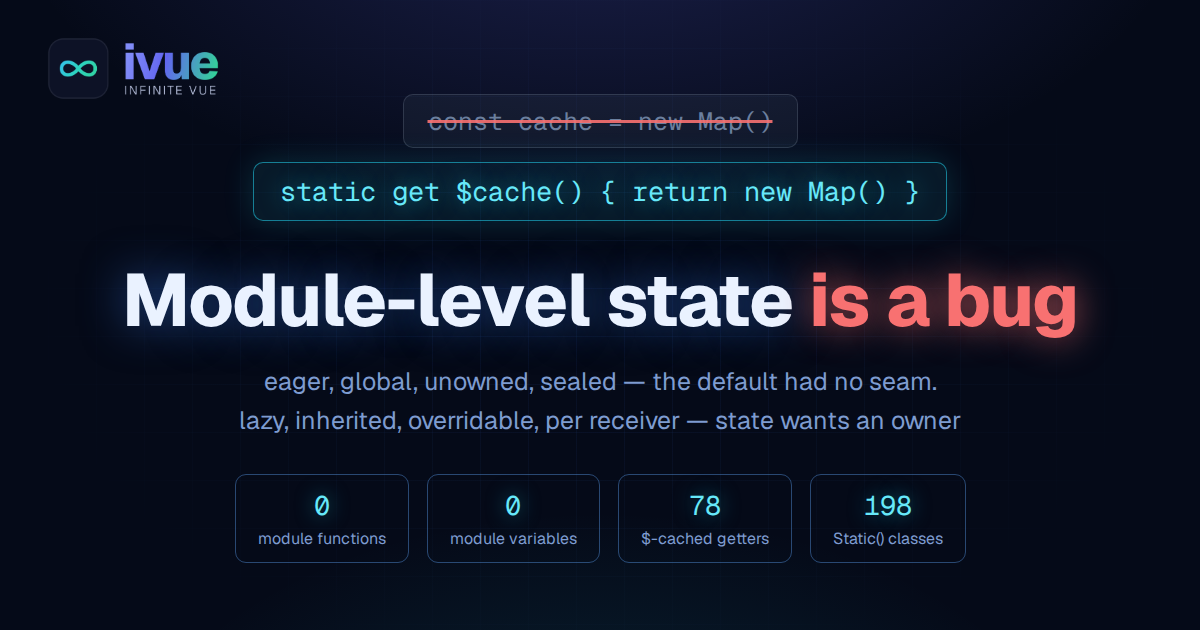
This is the most normal line in JavaScript:
const cache = new Map();It sits at the top of a module, above the exports, in essentially every codebase ever written. A memo table here, a registry there, a lazily-filled lookup, a singleton client, a pool. Nobody reviews it. Nobody flags it. It is so universal it has become invisible.
Read it slowly and it is a remarkable set of decisions to make in five words. That line declares state that is eager — allocated the moment anything imports the module, whether or not it is ever used. Process-global — one instance, forever, shared by every consumer including every test that ever touches the module. Unowned — it belongs to a file, so no class, no receiver, no hierarchy has any relationship to it. And sealed — nothing can override it, specialize it, or substitute it, because module scope has no seam.
That last property built an industry. vi.mock, jest.mock, proxy loaders, dependency-injection containers with module-shaped tokens — enormous machinery whose job is to intercept a module at the loader because the state inside it cannot be reached any other way.
Mocking frameworks are not testing tools. They are patches for state that lives where no seam can reach it.
JavaScript's two containers
The language has always offered exactly two long-lived homes for state: the module and the class. The ecosystem chose the module — and it is worth being precise about why, because the reason has expired.
The class was always the better container in kind. A class has a name that appears in types. It has a hierarchy — subclasses exist, and they can specialize what they inherit. It has a receiver — code inside it knows who it is running as. And it has a seam by construction: override the member.
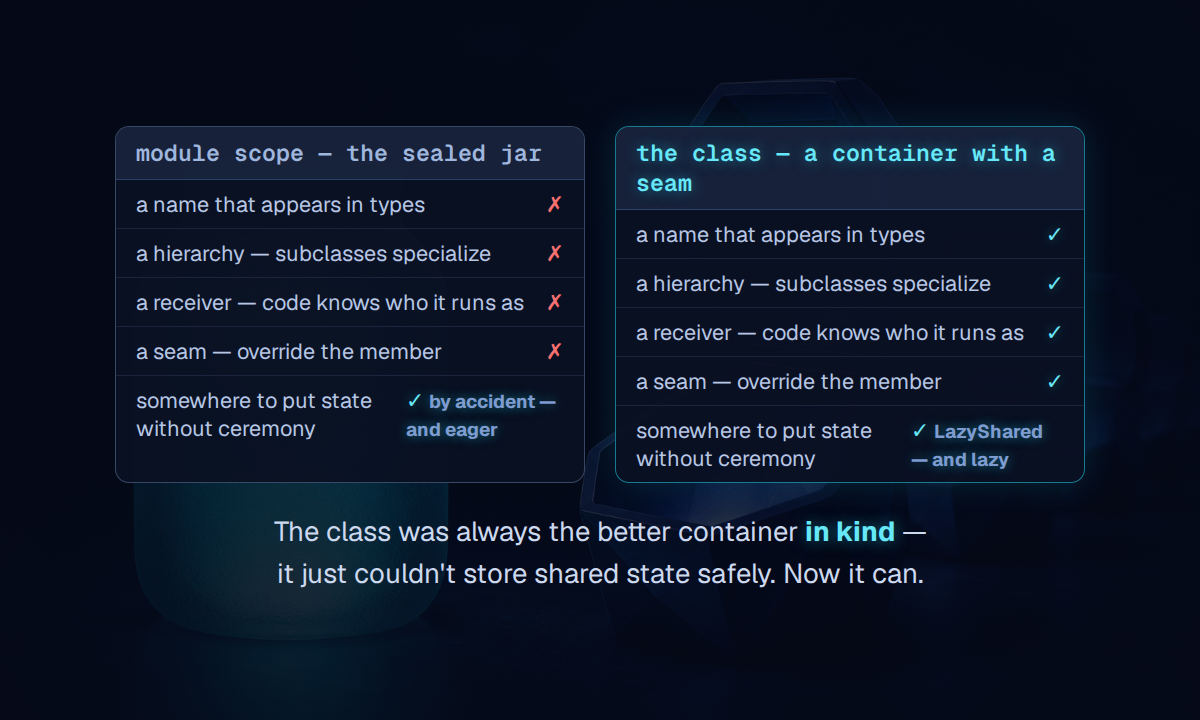
What the class lacked was one property module scope had by accident: somewhere to put state without ceremony. A static property = new Map() initializer is also eager — it runs when the class is defined, which is load time again. A hand-rolled lazy static — getter, backing field, null check, per-subclass bugs — is the kind of eight-line ritual nobody repeats four hundred times. So state went to the module, and every property in the paragraph above came with it.
Static() supplies the missing piece. Wrap a class once, and every $-prefixed static getter becomes evaluated on first read, cached per receiver, inheritable, and overridable — one declaration:
import { Static } from 'ivue/extras';

class $WrapIndex {
  // Lazy, owned, per-class, replaceable — and it reads like a getter
  // because it is one. First read runs the body; every later read
  // returns the same Map. `$` marks the contract: stable identity.
  protected static get $segmentsByLine(): Map<number, WrapSegment[]> {
    const segmentsByLine = new Map<number, WrapSegment[]>();
    return segmentsByLine;
  }
}

export namespace WrapIndex {
  export const $Class = Static($WrapIndex); // anchor — children `extends` this
  export let Class = $Class; // the published capability class
}The module-level const and this getter hold the same Map. Every other property differs:
The module is a file. Files don't inherit, don't specialize, don't appear in a type, and don't know who is asking. The class was always the better container — it just couldn't store anything lazily until now.
The ladder — what actually lives in these getters
The pattern would be a curiosity if it only held memo tables. What makes it a substrate is that one declaration form absorbs every kind of module-level state a real system accumulates. Invar — the 108,000-line terminal IDE built on ivue — runs 81 of these getters. A ladder of real cases, smallest to strangest:
A memo table. The wrap index above is Invar's own text-layout cache — a WeakMap from document to its line-wrap projection, so entries vanish with their documents. Nothing allocates until the first document wraps a line.
A platform object that is expensive to build. Unicode-correct cursor movement needs Intl.Segmenter, and constructing one is not free:
class $TextSegmentation {
  protected static get $graphemeSegmenter(): Intl.Segmenter {
    const graphemeSegmenter = new Intl.Segmenter(undefined, {
      granularity: 'grapheme',
    });
    return graphemeSegmenter;
  }
}Built on the first keystroke that needs it, owned by the class that understands it, and — because it is a getter on a hierarchy — a subclass in a test can hand back a stub segmenter without any loader tricks.
A native library handle. Invar's PTY layer binds libc through Bun's foreign-function interface — dlopen, symbol table, the works — inside a $-getter. A shared C library as a lazily-cached static property: opened once, on first terminal spawn, never in a process that doesn't open a terminal.
The import itself. This one rewires how you think about dependencies:
class $TypeScriptStructureAnalyzer {
  // The compiler is a 40 MB dependency. It loads once, on the first
  // structural query — and NEVER in a session that doesn't analyze
  // TypeScript. The cached value is the promise itself.
  protected static get $typescriptPromise(): Promise<typeof import('typescript')> {
    return import('typescript');
  }
}A dynamic import() is already lazy, but calling it twice loads twice into two promises. Cached under a $-getter, the promise becomes the singleton. Module-level top-level await — the ecosystem's usual answer — would put the 40 MB load back on the import-time clock for everyone.
The whole mutable snapshot. Invar's status channel keeps its entire published state — the object observers read — as one $-cached static. The $ contract is stable identity, not immutability: the object is mutated freely; what is guaranteed is that every reader, forever, is looking at the same object. That is exactly the contract a live snapshot needs, and exactly what a module-level let cannot promise once tests and workers enter the picture.
One form. Five completely different kinds of state. That collapse of variety is the point — where a conventional codebase has module constants, init functions, DI registrations, singleton getters, and let instance: T | null = null guards, this one has a getter with a $ on it, everywhere, and the uniformity itself becomes an instrument.
Per-receiver: the property module scope cannot have at any price
Static() caches per receiver. When a subclass reads an inherited $-getter, the getter body runs again for the subclass, and the result is cached on the subclass — sibling classes never share a table by accident, and a child that wants its own pool simply has one.
Module scope cannot express this. There is one file, therefore one Map, therefore every consumer shares — the file has no notion of "who is asking." The receiver-following cache is what turns storage into an inheritance-aware facility, and it is what makes the test story collapse into the test is a subclass:
class $RecordingSegmentation extends TextSegmentation.$Class {
  protected static get $graphemeSegmenter(): Intl.Segmenter {
    return buildInstrumentedSegmenter();
  }
}No vi.mock, no loader interception, no restore-after-each bookkeeping. The fake is a full citizen — the compiler type-checks it against the real member — and the real class's cache is never touched, because the subclass has its own. The entire mocking industry exists to simulate, at the loader, the seam this getter has by construction.
Measured at zero
The strong form of the claim is not "prefer this." It is that a serious codebase can run with no module-level state at all — and one does. Invar's conventions are machine-enforced by AST census (checkers that must first detect a planted violation before their pass counts — a boundary check that cannot fail is worse than none). Counted 2026-08-11, over 94,054 source lines and 372 files:
module-level functions:      0
module-level variables:      0
$-cached static getters:    78
Reactive() classes:         79
Static() capability classes: 198The zero is stricter than it had to be. The pattern's real target is state, not constants — a frozen lookup table at module scope harms nobody. Invar draws the line past even that: its validation constants — regular expressions, a reserved-name Set — live as static getters on the class that validates with them, so the metric is not "zero state, with constant exceptions." It is zero module-level declarations outright, held there by a grammar check that counts every violation by AST. The moment a value is written after load, or a test wishes it were different, it already belongs to a class — and here, everything does.
And the substrate is load-bearing enough that Invar verifies it at boot: startup constructs a throwaway class with a $TABLE getter, wraps it in Static(), and refuses to launch if two reads return different objects — with an error message telling you your node_modules is stale. An application that checks its language extension is present before it agrees to run.
The cost, honestly
Static() is opt-in from ivue/extras — 493 B gzipped, measured on the published 2.2.1 build, with no dependency on Vue or anything else; the identical idiom runs in Invar's backend modules under Bun. The discipline it asks for: the wrapper must sit at the namespace's $Class anchor so subclasses inherit the transform, and $ must be read as what it is — a stable- identity contract, not a freeze. The getter body runs once per receiver; if the body reads something that changes later, the cache holds the first answer, by design. State that must react belongs in instance getters returning refs — this pattern is the storage layer beneath that, not a substitute for it.
The flip
For thirty years, "where does long-lived state go?" had a default answer so ingrained it stopped looking like a decision. The default was wrong — not fatally, but taxably: eager when it could be lazy, global when it should be owned, sealed when it needed a seam, and propped up by an entire tooling genre built to pry files open at the loader.
One small transform moves the answer from the file to the class, and every one of those properties inverts at once. The measure of the flip is that a hundred-thousand-line system runs at zero — and boots by proving it.
State wants an owner. Now it can afford one.

Comments