
Three years to reduce, two weeks to build
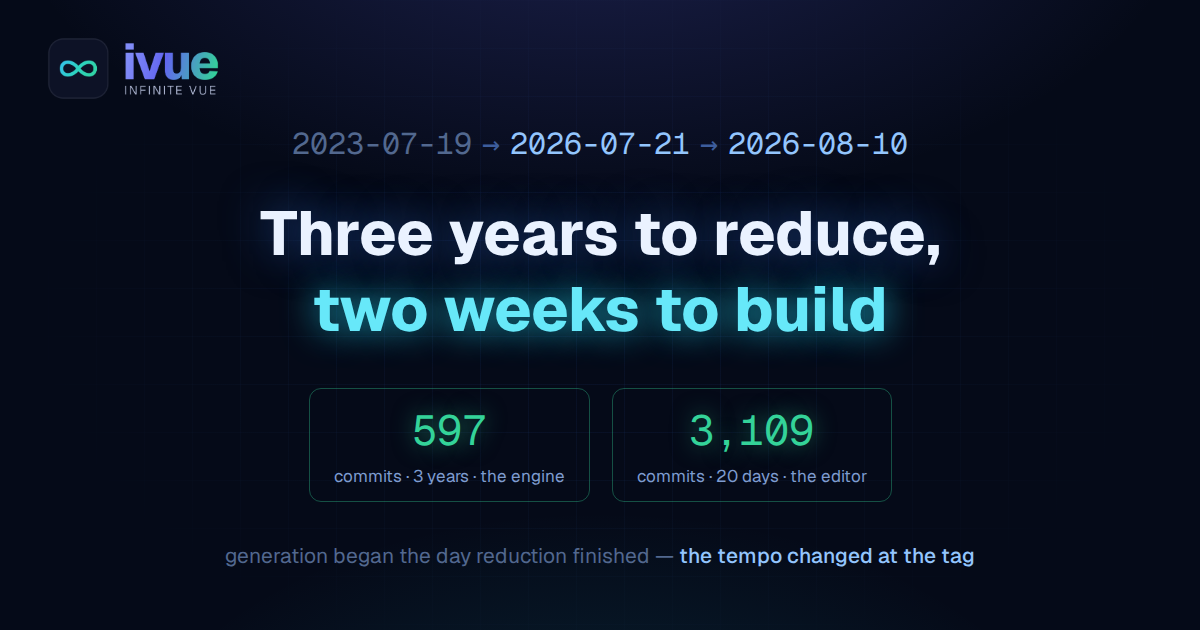
Three dates, from two public git logs:
2023-07-19   ivue's first commit
2026-07-21   ivue@2.0.0 tagged — the engine's final form
2026-07-21 Invar's first commit — the same dayThe library took 597 commits over three years — roughly one commit every other day. The editor built on it took 3,109 commits in twenty days — about 155 a day. A three-hundred-fold change of tempo, at a boundary you can point to in the history: the day the substrate was finished, construction began, and it never slowed down.
The two phases were different kinds of work
The slow phase was not slow building. It was reduction: finding which primitives a reactive class model actually needs, and discarding everything else. Three years of trying shapes, breaking them, and keeping only what survived — until the engine fit in 1.1 kB and its runtime model fit in a sentence. The commit rate was low because most of the work was deletion, and deletion does not fill a log.
The fast phase was generation: applying the finished primitives, over and over, at machine speed. AI agents wrote almost all of Invar — 173,430 lines of TypeScript (107,670 source, 65,760 tests, counted 2026-09-03), 39 invariant contracts, and on top of that a verification harness the size of the product itself — and could only do so because every class takes the same shape, every seam sits in the same place, and the failure classes that eat agent sessions (initialization order, unbound methods, memo discipline) had been removed by construction years earlier.
The tempo did not change because the tools got faster. It changed because the kind of work changed. Finding a generator is expensive. Running one is nearly free.

The conventional schedule, inverted
A ten-person team building an Invar-class IDE by hand prices out to roughly three years. The same wall-clock elapsed here — but the distribution inverted: the three years went into the substrate, and the product took a fortnight. Same calendar, opposite shape.
That inversion is the practical claim of this post. The instinct under deadline is to start building and let abstractions emerge. This history argues the reverse allocation wins when machines do the building: spend your years on the thing that makes construction cheap, then construct. The reduction is reusable; the fortnight is repeatable. Invar was the first two-week build on this substrate. There is no reason it is the last.
What one log can and cannot say
The three years bought domain knowledge too, and 2026 agents are not 2023 agents — but neither explains the shape of the data: the tempo change arrived at the tag, not gradually, and every discipline metric held at speed. Whatever was finished on 2026-07-21, it was the thing that had been missing.
Both logs are public. The dates are one git log away.

Comments