
Circular imports, dissolved
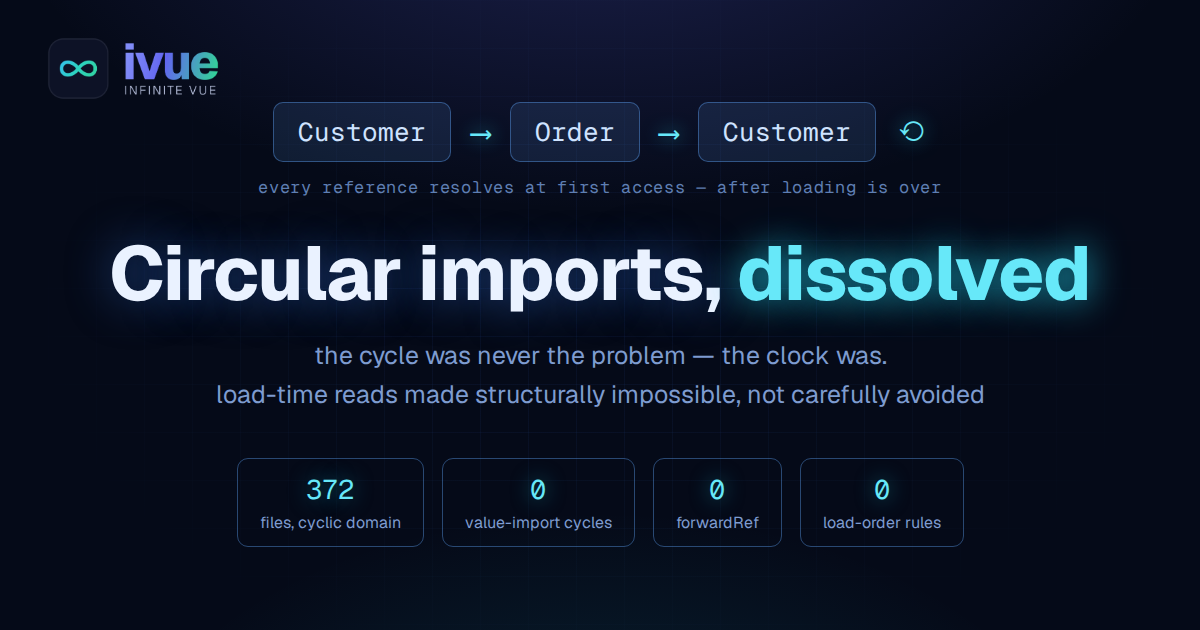
Every JavaScript codebase that grows past a few dozen files meets the same wall:
ReferenceError: Cannot access 'BaseView' before initializationSomewhere, module A imported B, and B — perhaps three hops away, through a barrel file nobody remembers writing — imported A. The loader had to pick which one evaluates first. It picked. Something read a binding that did not exist yet, and the program died before it ran.
The ecosystem has spent fifteen years treating this as a fact of nature — something to lint against, refactor around, and inject past. It is not a fact of nature. It is a timing error, and it has a structural fix so complete that a 372-file codebase with a deeply circular domain graph can measure zero import cycles — not because the cycles were broken, but because they stopped mattering.
The crash is real — the diagnosis is wrong
Here is what actually happens. When an ES module graph loads, the runtime evaluates modules depth-first: before your module's body runs, each of its imports runs first. A cycle makes that impossible for everyone — someone in the loop has to go first, and while it evaluates, the modules that point back at it are only half-initialized. ES modules handle this gracefully in the mechanism: imported bindings are live — views onto the exporting module's slots, not copies — so a binding that is undefined during loading becomes real the moment its module finishes.
Which means the crash never comes from the cycle itself. It comes from code that reads a binding at load time — while the graph is still initializing:
// The everyday load-time reads — each one is a bomb in a cycle:
class MenuView extends BaseView {}          // extends evaluates NOW
export const registry = new Registry();     // top-level construction
export const config = loadConfig(paths);    // top-level call
const client = createClient(Settings.url); // top-level dependency readMove the read to run time — inside a method, a getter, a callback — and the same cycle is harmless, because by the time any method runs, every module in the graph has finished loading. CommonJS tells the same story with worse manners: instead of a ReferenceError you get a half-filled exports object and an undefined that detonates minutes later, somewhere else.
A cycle never crashes a program. A load-time read of a half-initialized module does. The cycle just arranges the meeting.
The language did its half of the work when ES modules shipped live bindings. What the ecosystem never supplied was the other half: a way to write code where load-time reads of other modules cannot occur. Not "are avoided when everyone is careful" — cannot occur, by the shape of the code.
The domain was never acyclic
Before the fix, look at what the standard workarounds actually cost, because the price is paid in design, not syntax.
A customer has orders; an order belongs to a customer. A workspace holds documents; a document knows its workspace. An editor owns a selection; the selection reaches back to the editor to scroll itself into view. Domain graphs are cyclic because reality is cyclic — mutual reference is what it means for two things to be related.
The ecosystem's tools all answer this by bending the domain to please the loader:
import/no-cycle— a lint rule that bans the topology outright. Teams obey it by merging cohesive files into one, or extracting shared fragments intoutils/dumping grounds whose only design rationale is "the linter stopped complaining."forwardRef— Angular and NestJS ship a function whose entire purpose is to wrap a reference in a closure so the framework reads it later:@Inject(forwardRef(() => OrderService)). It is the correct instinct — defer the read — expressed as a per-site patch with a warning label, applied only after the crash tells you where.- Deferred
import()— turning a static dependency into an async one, infecting every caller with aPromise, to solve a problem that has nothing to do with asynchrony. - Load-order rituals — README sections explaining which barrel file must be imported first. Order-sensitivity as documentation.
Every one of these treats the symptom at one call site and leaves the disease in place. And the disease compounds: the workarounds are viral (one forwardRef breeds more), invisible until runtime, and worst of all they push teams toward acyclic architectures for cyclic domains — the model contorted to fit the loader.
The object graph is cyclic because the world is cyclic. A lint rule cannot fix the world.
The reduction: it was never the cycle — it was the clock
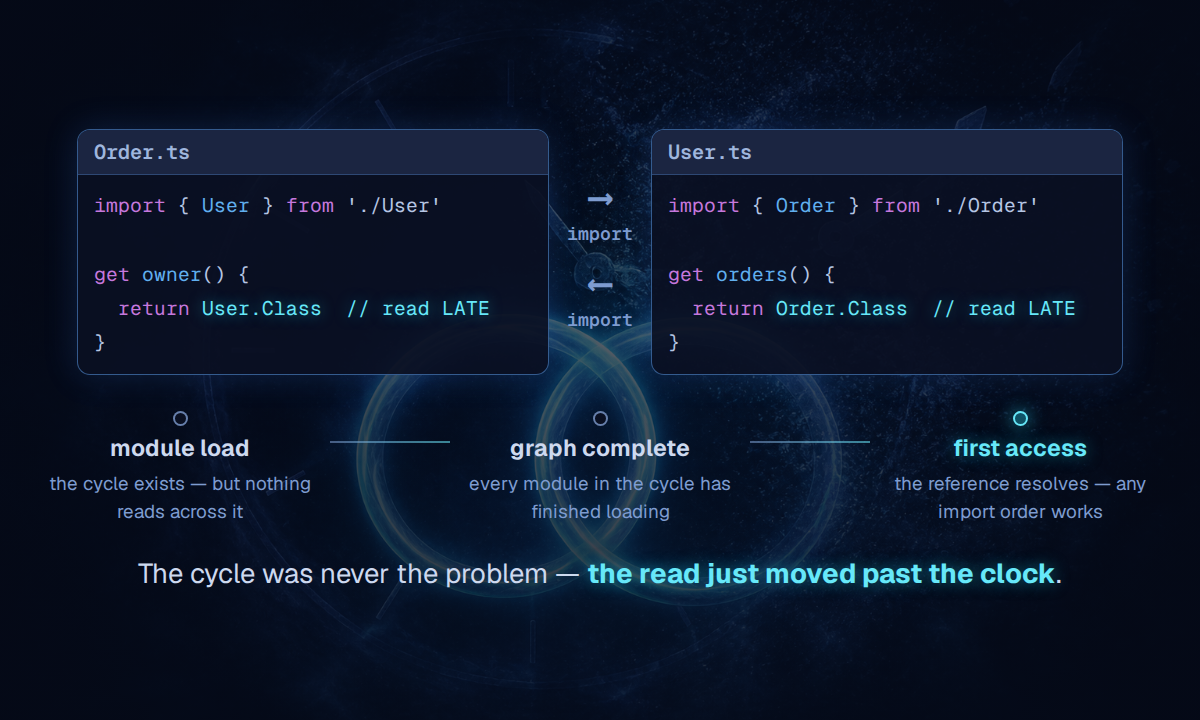
Strip the problem to its load-bearing structure and one variable remains. A program has two clocks:
- Load time — modules evaluating, in some order, with the ordering constraint that causes everything above.
- Run time — everything after. No ordering constraint exists here, because loading is over. Every module is complete.
A reference is dangerous or safe depending on which clock it reads on — nothing else. The topology is irrelevant. So the fix is not to break cycles, manage cycles, or document cycles. It is to move every cross-module reference to the second clock, structurally, so that no discipline, vigilance, or lint rule is ever needed again.
That is what the namespace pattern does.
The idiom
Every class module exports the same three-line namespace:
// Customer.ts
import { Reactive } from 'ivue';
import { ref } from 'vue';
import { Order } from './Order';

class $Customer {
  constructor(public name: string) {}

  get orders() {
    return ref<Order.Model[]>([]);
  }

  // Access-time reference: `Order.Class` is read when this METHOD
  // runs — long after every module has finished loading.
  placeOrder(total: number) {
    const order = new Order.Class(this, total);
    this.orders.value.push(order);
    return order;
  }
}

export namespace Customer {
  export const $Class = $Customer; // raw — children `extends` this
  export let Class = Reactive($Class); // reactive — you `new` this
  export type Instance = typeof Class.Instance;
  export type Model = InstanceType<typeof Class>; // raw-instance type
}// Order.ts
import { Reactive } from 'ivue';
import { ref } from 'vue';
import { Customer } from './Customer';
class $Order {
constructor(
public customer: Customer.Model, // type-space reference — free
public total: number,
) {}
get status() {
return ref<'open' | 'shipped'>('open');
}
// Access-time reference back into the module that references us.
// The cycle is COMPLETE — Customer needs Order, Order needs
// Customer — and nothing anywhere can observe it.
customerName() {
return this.customer.name;
}
}
export namespace Order {
export const $Class = $Order; // raw — children `extends` this
export let Class = Reactive($Class); // reactive — you `new` this
export type Instance = typeof Class.Instance;
export type Model = InstanceType<typeof Class>;
}Look at what each piece does to the clock:
- The import is load-time, but it only touches the namespace object — a container created the instant its module starts evaluating. Nobody reads
Order.Classthrough it yet. - Every cross-module value reference lives inside a method or getter body —
new Order.Class(...), a store touched through a$-cached getter, a capability class read through a static getter. All of it runs on the second clock. - Services and capability classes get the same one-liner. The shape Invar uses at thirty sites:
class $TextEditing {
  // Late dependency read: the LIVE class slot, resolved per call.
  // Cycle-proof, subclass-overridable, zero-cost DI — one line.
  protected static get Files() {
    return Files.Class;
  }

  // the one cast per class — instance code reads statics through it
  protected get self() {
    return this.constructor as typeof $TextEditing;
  }

  saveActiveDocument() {
    return this.self.Files.write(this.activePath());
  }
}No container, no decorators, no registration step, no forwardRef. The "dependency injection framework" is a property read that happens to occur after loading has finished.
The one eager edge is the one that cannot be circular
One cross-module reference stays on the first clock: inheritance. class $Container extends BaseElement.$Class evaluates at load time — that is why the namespace publishes the immutable $Class anchor for children to extend.
And this is the quietly beautiful part: inheritance is the one relation that is acyclic by logic, not by discipline. A class cannot be its own ancestor — not in JavaScript, not in any language, not as a matter of syntax but as a matter of what "ancestor" means. So the pattern's partition lands exactly on the joint:
Eager where cycles are logically impossible. Lazy where cycles are legal. The pattern splits references along the same line the problem does — which is why nothing leaks.
There is no residue. The references that can form cycles all resolve at access time; the reference that resolves at load time cannot form one. The failure mode does not become rare. It becomes inexpressible.
Types ride free
Notice Customer.Model in $Order's constructor — a type-space reference into the module that value-references us back. This costs nothing, ever: TypeScript erases type imports at compile time, so a type-level cycle evaluates no code and cannot crash anything.
The pattern therefore splits the two spaces exactly where the language splits them. Type space may be as cyclic as the domain demands — mutual typing is the normal case, not an exception. Value space is acyclic-in-effect — not because the edges are gone, but because none of them is read while order matters.
Invar's import graph shows both halves at once: four type-level strongly-connected components exist — the largest spans nine files across the workspace, syntax, and search modules — and they are completely inert. Nobody breaks them up, because there is nothing to break.
Measured at scale
Claims about module hygiene are usually vibes. This one is a graph algorithm. Invar — the terminal IDE built on ivue — is 372 source files across 37 modules, 94,054 lines, with exactly the kind of domain that produces import-cycle hell: workspaces hold documents, documents reach language services, language services reach back into workspaces, plugins touch everything.
A codebase's imports form a directed graph: every file is a node, and an edge runs from A to B when A imports B. A cycle is any path that returns to its start. But "count the cycles" is the wrong question to ask that graph — the number of distinct cycles can grow exponentially with graph size, which is why cycle-listing tools on tangled codebases either truncate their output or grind forever. The well-posed question is: how many knots? A knot — formally a strongly connected component — is a maximal group of files that can all reach each other through imports. Every cycle, however long and however many there are, lives entirely inside one knot. Zero knots of two or more files means zero cycles — provably, not probably.
That question has a famous answer. Tarjan's algorithm (Robert Tarjan, 1972) finds every strongly connected component in a single depth-first traversal — linear in files plus imports. Each file gets a visit index on first arrival and a lowlink: the smallest index reachable from anywhere in its subtree. When the traversal finishes a file whose lowlink still equals its own index, everything above it on the visit stack peels off as one component. One pass, no revisits, mathematically complete — it cannot miss a cycle, at any scale.
The whole audit is seventy lines with zero dependencies — walk the tree, regex the imports, run Tarjan twice: once over value imports (edges that survive compilation) and once over all imports including import type (edges that exist only for the type checker and are erased before anything runs). Point it at any codebase: node cycle-audit.mjs src.
Invar's numbers (measured 2026-08-11; type-declaration files carry no value imports and are excluded):
files analyzed:                 371
value-import knots:               0
type-only knots:                  4   (largest: 9 files — inert)
forwardRef sites:                 0
cycle-breaking dynamic imports: 0The three await import() calls in the entire codebase load third-party vendor plugin artifacts and a platform introspection module — things that are genuinely dynamic. Not one exists to dodge initialization order.
Zero is the interesting number because of what it makes impossible: there is no arrangement of these 372 files' load order that changes the program's behavior. Load order — the thing entire README sections, lint configs, and framework features exist to manage — has ceased to be a variable. Nobody on that codebase has ever debugged an initialization-order crash, drawn an import graph on a whiteboard, or extracted a third module to appease a linter. The problem is not handled well. It is absent.
Why zero is normally out of reach
Run any cycle detector against a mature codebase and the normal result is dozens of knots — sometimes hundreds. Teams triage the list, allowlist the worst offenders, and eventually mute the rule. That is not because those teams are careless. It is because, under the ordinary way of writing JavaScript, the value-import graph mirrors the domain graph — a load-time binding per relationship — and the domain graph is cyclic. The cycles in the report are the shape of the model.
Which leaves cleanup with only two levers. Distort the domain — merge mutually-referencing files, invert relationships, insert indirection layers — and buy zero at the price of the model. Or change when references resolve, so the domain keeps its shape while the load-time graph empties. The ecosystem's tools are all partial versions of the second lever applied per crash site; the namespace pattern is the second lever applied everywhere, by construction.
The two-graph measurement shows the decoupling directly, and this is the part a cycle report normally cannot say. The type graph still holds four knots — the domain's true cyclic shape, visible to the same algorithm, undistorted. The value graph holds zero — because a knot needs load-time edges to stand on, and the idiom leaves none. In an ordinary codebase those two numbers are chained together; here one is the domain and the other is the discipline, and they read independently.
We have not measured every codebase, so take the general claim the right way around: the script is seventy dependency-free lines — run it on yours, and see which lever your zero would need.
The cost, honestly
The discipline is real and worth stating plainly. Cross-module references go through the namespace — Order.Class, not a bare imported class binding — one level of indirection at every use site. Top-level instantiation is given up entirely: no export const registry = new Registry(), no module-scope side effects, no export default class. Each getter read costs a property access — nanoseconds, and the $-cached form amortizes even that.
And one thing stays impossible forever: circular extends. The pattern does not fix it because nothing can — it is logically incoherent, not technically hard. If you believe you need it, the model is wrong, not the loader.
What you get back is the disappearance of an entire failure class — not mitigated, not linted, not documented: unexpressible. The same construction-over-vigilance trade that runs through everything else ivue does.
The position
None of this touches the loader. There is no bundler plugin, no custom resolver, no build step, no framework runtime mediating your imports. The namespace pattern is plain JavaScript — it works in Node and Bun with no Vue in sight, which is why Invar's non-UI modules use the identical shape.
That is the claim worth making precisely. JavaScript did not need a new module system — it needed its references moved to the right clock, and it needed the move to be structural, so that correctness is a property of the shape rather than a habit of the team. Fifteen years of forwardRef, cycle linting, and barrel-file liturgy were spent managing a problem that one exported namespace and a getter-shaped reference dissolve outright.
The wound was never the cycle. It was the clock. Set the clock right, and the oldest structural problem in JavaScript does not get easier to manage.
It gets impossible to have.

Comments