
The object graph they took from you
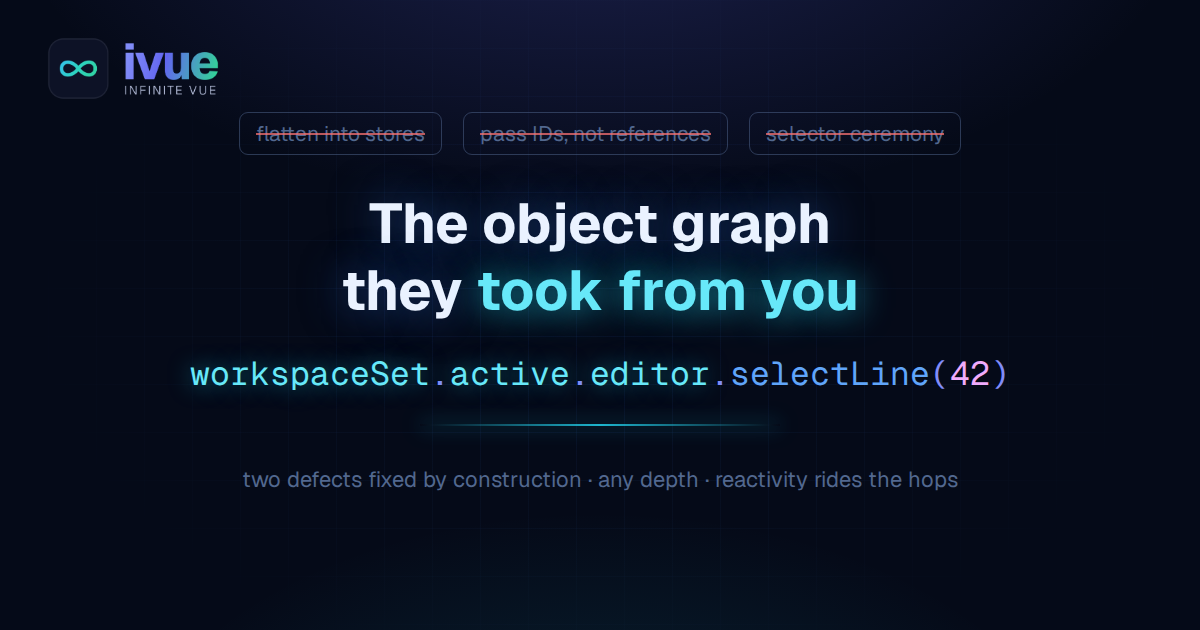
Read this expression slowly:
workspaceSet.active.editor.selectLine(42);It reads like the domain because it is the domain: a set of workspaces, the active one, its editor, an action. No store lookup, no ID passed to a selector, no hook ceremony. Every hop is a plain property; the method at the end arrives already bound.
Most frontend codebases cannot write that sentence. Not because object graphs were proven wrong — nobody ever proved that — but because two mechanical defects made them unreliable, and the ecosystem fled. Then it did something stranger: it canonized the flight as philosophy.
The two defects
Defect one: module-cycle initialization order. Domain models are cyclic by nature. A workspace holds editors; an editor knows its workspace. Put those classes in two files — where they belong — and the imports form a cycle. In JavaScript's module system, a class binding read before its module finishes evaluating throws Cannot access 'X' before initialization. Whether that happens depends on load order, which depends on entry points and bundler whims. The graph worked on Tuesday and crashed after a refactor moved an import line.
Defect two: unbound methods. Detach a method from its object — hand it to an event listener, a callback, an array of handlers — and this falls off. Every team patched it per-site: arrow-function fields here, .bind(this) there, a wrapper closure somewhere else. Every patch was a small tax, and forgetting one was a runtime bug.
Neither defect was ever fixed. So the ecosystem routed around them.
The flight
Each workaround was locally reasonable:
- Flatten the model into stores. No cross-references between classes if there are no classes — just one bag of state per domain noun.
- Pass IDs instead of references.
editor.workspaceis a cycle risk;editor.workspaceIdplus a lookup is "safe." - Select instead of navigate. If state is flat, reaching anything means a selector: find the active workspace, join it to its editor, memoize the join.
- Atomize logic into closure factories. A function scope can't have a
thisproblem if there is nothis.
Stack the workarounds and you get the architecture a generation learned as best practice: state normalized like a database, logic in composable functions, entities referenced by ID, every relationship reassembled at read time by selector code that exists only because the references were confiscated. The industry name for the result is the anemic domain model — data in one flat bag, behavior in another — and in frontend it stopped being an anti-pattern and became the default. Not because anyone chose it on the merits. Because hop two of a real object graph could throw depending on import order.

The homecoming
Both defects die by construction in ivue's namespace pattern:
- Cycles never manifest because every cross-module reference is late-bound — getter bodies, method bodies, first access. The import graph can contain cycles; nothing reads another module's value while modules are still initializing. The property is per-edge, so depth is unlimited: hop five is exactly as safe as hop one, because each dereference resolves at call time.
- Methods arrive bound because the engine lazily binds them to the raw instance with stable identity —
instance.methodis the same function every read, safe to detach, hand to a listener, keep in a registry.
And reactivity rides the same hops. State is ref() at the leaves, .value at the reads — and tracking follows whatever property path the read takes, at any depth:
// WorkspaceSet.ts
import { Reactive } from 'ivue';
import { shallowRef } from 'vue';
import { Workspace } from './Workspace';

class $WorkspaceSet {
  get workspaces() {
    return shallowRef<Workspace.Model[]>([]);
  }
  get activeIndex() {
    return shallowRef(0);
  }

  // a plain getter — the graph hop IS the derivation
  get active() {
    return this.workspaces.value[this.activeIndex.value];
  }
}

export namespace WorkspaceSet {
  export const $Class = $WorkspaceSet; // raw — children `extends` this
  export let Class = Reactive($Class); // reactive — you `new` this
  // the type of every unwrapping surface (defineExpose, reactive())
  export type Instance = typeof Class.Instance;
}A watcher that reads workspaceSet.active.editor.cursorLine.value subscribes to the active index, the workspace list, and the cursor — the whole path — because the reads happened inside its effect. Switch workspaces and it re-fires; no selector was written, no subscription managed. Two primitives, any depth. Much of what ships under the name "state management" is scaffolding around the missing graph.
Proof at depth
Invar, the terminal editor built by AI agents on ivue, navigates its domain exactly this way. These are production lines from its composition root, quoted verbatim:
// RootView.ts — a reactive leaf read, four hops deep
editorArea.title = workspaceSet.active.editor.hasDocument.value
  ? workspaceSet.active.editor.title
  : 'Editor';

// RootView.ts — five hops, crossing TWO namespaces in one expression
languageForActive: () =>
LanguageRegistry.Class.forPath(workspaceSet.active.editor.document.path),Look at what each line takes for granted. The first reads a ref leaf (hasDocument.value) through three graph hops and a plain-getter derivation (title) beside it — inside a paint effect, so the title re-renders when the active workspace changes, the editor swaps, or the document opens. Nobody wrote a selector for that; the reads are the subscription. The second navigates the workspace graph AND dereferences a second module's replaceable Static() seam — LanguageRegistry.Class — in the same expression. Under eager binding, that line is a load-order lottery ticket. Late-bound, it is just a sentence.
They are two of 75 multi-hop call sites counted across the editor's 153 files (grep, July 2026), written across 292 commits by authors who were never once bitten by initialization order. The fear was about the defects. It was never about the shape.
What stays true
A claim this shaped earns its keep by what it rules out, so here is what stays ruled out:
- Circular
extendsstays impossible — a class can't be its own ancestor. That is logic, not a limitation; no pattern restores it. - Eager top-level reads stay dangerous —
new B.Class()at module scope executes at load time, inside the danger window. The convention works because it makes every reference late; it does not bless eager ones. - Normalization keeps its real jobs. Deduplicating a server cache and syncing entities by ID across a wire are storage problems, and ID-keyed maps solve them well. The correction is narrower: your runtime domain model — the thing your logic navigates — no longer has to be flattened in fear.
The triptych
This is the third confiscation ivue reverses, and the corrections compose. Inheritance was exiled for the sins of its abusers — the philosophy correction. Objects were rented from framework lifetimes — the lifetime correction. And the graph itself was taken — the composition correction. Put them back together and you get the thing frontend quietly stopped believing it deserved: a rich, reactive, navigable domain model, in plain classes, at any depth.
workspaceSet.active.editor.selectLine(42) — welcome home.

Comments