
Reactive() is all you need
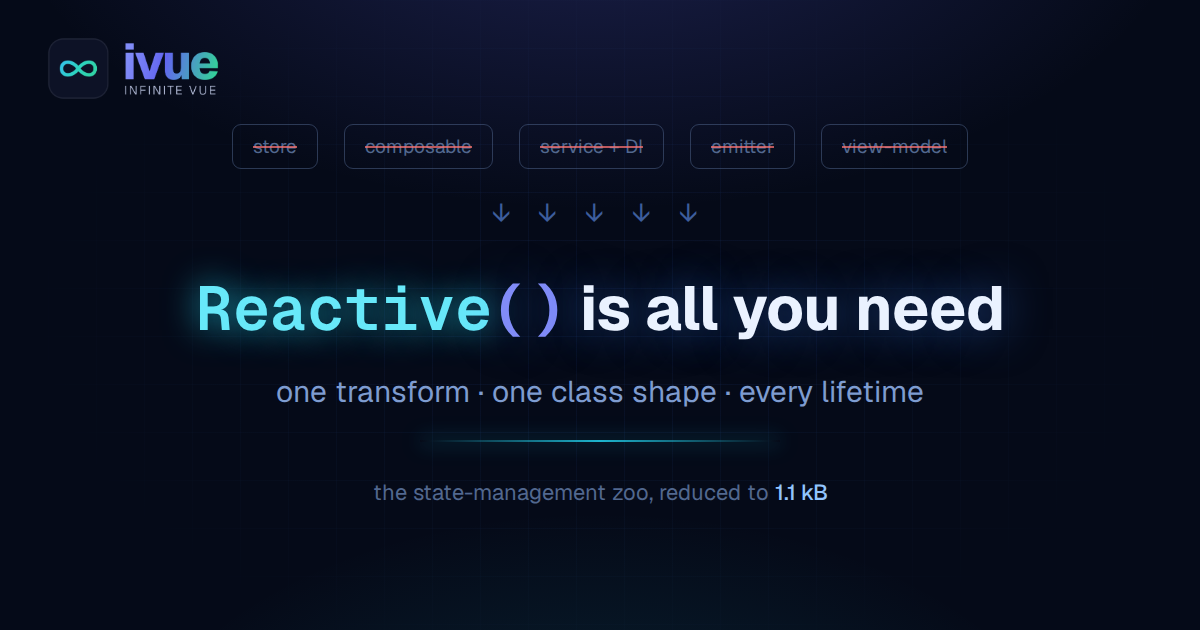
The most influential machine-learning paper of the last decade is famous for its title before its math. Attention Is All You Need didn't claim attention was magic — it claimed the zoo was unnecessary: the recurrent networks, the convolutional encoders, the task-specific architectures bolted together per problem could all be replaced by one primitive, repeated.
Frontend state management has a zoo of its own. A mature Vue application typically carries a store library for shared state, a composable convention for reusable logic, a service layer for "business logic," an event emitter for cross-module signals, and some flavor of dependency injection to wire it together. Five categories. Five APIs, five lifecycle stories, five sets of documentation, five ways a new team member can put code in the wrong place.
The claim of this post is the paper's claim: the zoo is unnecessary. Every one of those categories is the same three needs wearing different uniforms — state, derivations of state, and actions that mutate state — plus one honest variable: how long the thing lives.
The zoo, reduced
Hold a Reactive() class against each category and watch the category dissolve:
| the category | what it actually is | as a Reactive class |
|---|---|---|
| store | shared state + derivations + actions, app lifetime | a module-singleton instance |
| composable | state + derivations + actions, caller's lifetime | the same class, constructed where you need it |
| service | actions around injected dependencies | methods + $-getter injections |
| view-model | state + derivations bound to one component | the same class, constructed in setup() |
| domain entity | state + derivations + actions, data lifetime | the same class, thousands of instances |
Five rows, one right-hand column. The categories were never different kinds of thing — they were one kind of thing at different lifetimes, and the ecosystem shipped a separate library for each lifetime because no primitive spanned them.
Reactive() spans them. The constructor runs synchronously wherever you new — construct in setup() and plain watch/onMounted register against the component; construct at module scope and $watch registers in the instance's own detached scope, disposed by an owner calling $stopEffects(). Same class, both lifetimes, chosen at the call site — the one variable that was ever real is the one you control directly.
What each library was compensating for
Each cage in the zoo exists because plain classes historically couldn't do the job:
- Store libraries exist because sharing a reactive object across components needed framework blessing. A Reactive instance is a plain object with cached Refs — export it from a module and it is shared, no plugin, no
install(). - Composable factories exist because logic reuse needed a function scope to hold refs. A class holds them on the prototype pattern instead — with inheritance,
instanceof, and circular-import immunity the closure never had. - Service layers with DI exist because classes constructed eagerly couldn't safely touch stores at load time. The
$-getter resolves dependencies on first access, after everything is installed — injection without a container. - Event emitters exist to signal across modules without coupling. A watcher on a ref is that signal, with teardown owned by
$stopEffects()instead of a manualoff()bookkeeping ledger.
None of these libraries was a mistake. Each was the correct patch for a missing primitive. The primitive stopped being missing.
Proof by existence
This is not a thought experiment. Invar, the terminal code editor built almost entirely by AI agents, is 25,890 lines with no store library, no DI container, no emitter, no composable layer: 42 Reactive() classes cover every stateful role in the table above, 34 Static() seams cover the stateless capabilities, and the whole model layer underneath is 1.1 kB. The 20,000,000-cell spreadsheet runs the same way. So does every demo on this site.
What "all" does not mean
A claim shaped like this one earns its keep by what it rules out, so here is the boundary, stated plainly:
- Rendering is not ivue's job. Vue owns templates and the DOM; OpenTUI owns Invar's framebuffer.
Reactive()is the model layer under a renderer, not a renderer. - The static side has its own transform. Stateless capability classes — function bags behind a replaceable seam — belong to
Static(), which has no instance dimension. - Persistence, routing, and I/O stay themselves. The claim collapses the state-architecture middle layer — the five-category zoo between your data and your renderer — not your HTTP client.
Inside that boundary, the reduction is total: if the thing holds reactive state, derives from it, or mutates it, it is a plain class with one transform applied, and its only design decision is its lifetime.
One kilobyte because one idea
The engine is 1.1 kB for the same reason the transformer outlived the zoo it replaced: removing categories removes machinery. No store plugin, no injection tokens, no emitter registry, no composable-context rules — one transform over one class shape, applied identically at every lifetime.
The paper's lesson was never that attention was powerful. It was that the specialized architectures were redundant — that one primitive, honestly scaled, covered what a zoo of them had been covering badly.
Your state management has been telling you the same thing. Reactive() is all you need.

Comments