
Reactive framework for the AI era
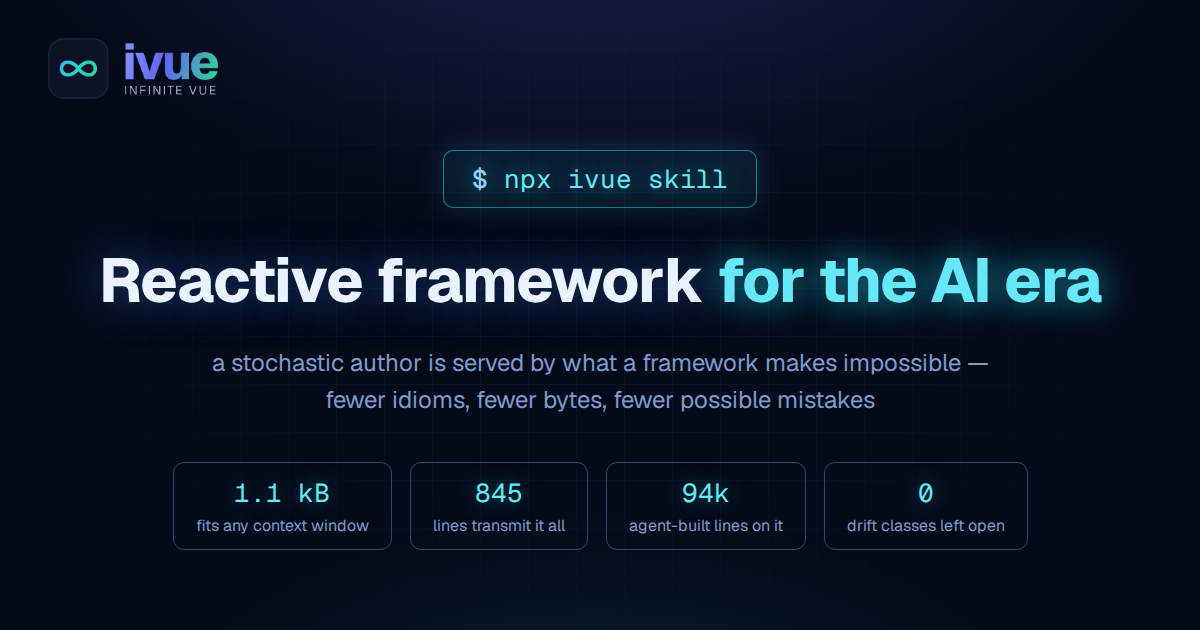
Every framework you know was designed for a human author. The virtues frameworks compete on — expressiveness, flexibility, freedom of style, a rich menu of ways to do each thing — are virtues for a person: they respect taste, they accommodate teams that disagree, they make the language feel roomy.
The author is changing. On a growing share of real codebases, most lines are written by agents — and for a stochastic author, the ranking of framework virtues does not shift. It inverts.
A human author is served by what a framework lets you express. A stochastic author is served by what a framework makes impossible.
ivue was not designed for agents — it was reduced over three years for humans who were tired of variance. But reduction and the AI era arrived at the same doorstep, and it is worth being precise about why.
What a stochastic author actually needs
An agent is a stochastic rule-follower: fluent, tireless, and drifting. Every property below exists to convert drift into something harmless, visible, or impossible.
One way to do each thing. Where a framework offers five idioms, a human picks a favorite; an agent samples all five across a codebase, and every seam between idioms is a place reasoning can slip. ivue has one class shape, one export form, one wiring pattern — which is why uniformity works as an instrument: against total sameness, an agent's deviation is high-contrast, catchable by an AST check instead of a careful reviewer.
Correctness by construction, not vigilance. The classic review-burden failure classes — unbound this, initialization order, circular imports, leaked watchers, module-level state — are exactly the mistakes a tireless generator makes tirelessly. ivue's answer is never "be careful": methods bind lazily and permanently, cycles resolve by construction, teardown is deterministic. A failure class an agent cannot express is a failure class nobody has to catch.
A standard small enough to transmit whole. The entire discipline fits in the 845-line Standard Operating Manual — installable into an agent with one command:
npx ivue skill        # Claude Code
npx ivue skill --all # + Cursor, Codex, Gemini…And here the catalog-versus-generator distinction becomes economic. A big framework transmits as examples, and examples teach imitation. A small model transmits as rules, and rules teach derivation — agents holding the ivue standard produced correct patterns its own author had never written. You cannot fit a sprawling API into a context window and have it survive; you can fit a generator.
Legibility at runtime. An ivue application is one navigable object graph — workspaceSet.active.editor.selectLine — with no store indirection between the agent and the state. In Invar, that graph is queryable from outside the process by dotted path: agents verify their own work by asking the program, not by parsing screenshots. When the object tells the truth, the agent can read it.
Edits that land on live state. ivue's thin-closure rule means logic lives on the prototype, so an agent's edit hot-grafts onto running instances — state intact, no remount, production semantics. The agent-edit-verify loop runs against the live app instead of a restart cycle.
Small is a context-window property now
For years, 1.1 kB read as a bundle-size brag. In the AI era it means something better: the entire engine fits in one head — any head. A human holds the whole runtime model; an agent holds it perfectly, with room left for your actual domain. Every kilobyte of framework API is context an agent spends on the tool instead of the problem — and every behavior too subtle to state in a rule is a behavior agents will get differently each time.
An API you can hold in your head is an API an agent can hold in its context — whole, with no paraphrase loss. Small stopped being a flex. It became a bandwidth requirement.
The evidence is not hypothetical
This argument has a running proof: a full terminal IDE — 107,670 source lines, 384 classes, built by an agent fleet in six weeks on this exact substrate. The discipline numbers held while it quadrupled: zero import cycles, zero module-level state, twelve computed() calls, one hundred percent class-shape conformance — each zero enforced mechanically, on every merge. And the part that matters most for this article's claim: the agents were not imitating examples. They derived patterns no human had shown them, because what they were given was not a catalog but a model.
The human counterweight
None of this is a framework against people. Read the list again — one idiom, structural guarantees, a small API, legible state, verifiable conventions — that is what senior engineers have begged for on human teams for decades. Agents did not create these virtues; they removed the tolerance for their absence. A human can compensate for variance with experience and care, indefinitely and expensively. An agent cannot compensate, so the structure has to — and once the structure does, humans get the same gift: code where the care lives in the shape, not in the reviewer.
The claim is economic, and it is blunt: every unit of variance is tokens an agent spends fighting the framework instead of building your product — and the tempo data says that exchange rate is steep.
What frameworks compete on now
For thirty years, frameworks competed on what they let you express. That contest assumed the scarce resource was human effort, and expressiveness saved it. The scarce resources now are context, verifiability, and drift-resistance — and those are won by subtraction: fewer idioms, fewer bytes, fewer possible mistakes.
ivue got there by accident of honesty — three years of deleting everything that did not have to exist, finished the same day the agents arrived. The result is a reactive framework whose entire contract an agent can hold, whose violations a script can see, and whose failure classes are not reviewed away but gone.
That is what "for the AI era" means here. Not a chatbot in the docs. A substrate an agent cannot hold wrong.

Comments