Uniformity is an instrument
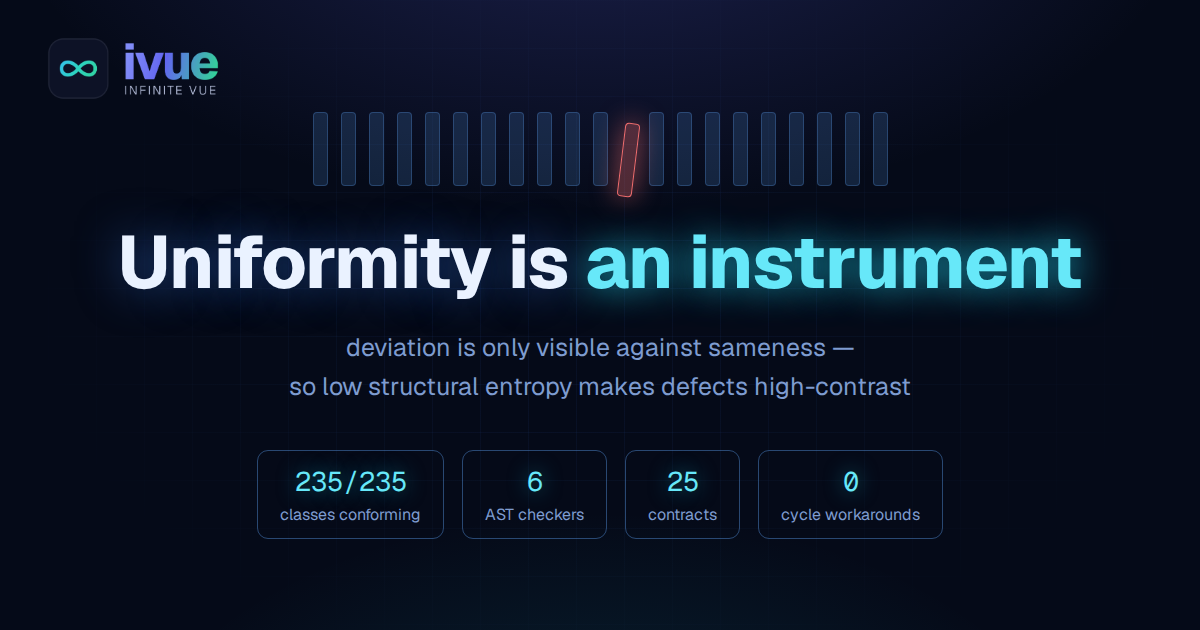
Every team argues about consistency as though it were manners. Naming conventions, file layout, one way to do dependency injection — the case for it is usually comfort: new people onboard faster, diffs read cleaner, nobody bikesheds.
That case is true and far too small. Uniformity is not a courtesy. It is a detection apparatus, and it is the cheapest one available.
The reason is one sentence: deviation is only detectable against a background of sameness. A codebase with low structural entropy makes its own defects high-contrast. A codebase without one hides them in noise — not because the defects are subtler, but because there is no baseline to be a defect from.
What sealing actually looks like
Invar — the terminal IDE AI agents build under contracts and a merge gate — takes this to its limit. Every class in 62,401 lines of source is published through the namespace pattern: a raw $Class declaration, a mutable Class slot, dependencies read late. Not most classes. 235 of 235.
That is not achieved by asking nicely. It is enforced by six AST checkers that walk the TypeScript program itself — not a lint config, a compiler-level analysis:
- a file grammar check: behavior must be structurally reachable through the file's eponymous class seam;
- a reactive observation check: a per-frame read must resolve its source live, not from a snapshot;
- a static getter naming check and an ivue capability check:
$-prefixed statics mean compute-once, and the class must actually be published through a transform that grants it; - a harness wait check: every wait must observe the state it asserts;
- a coverage ratchet: coverage may fall, but never silently.
Add the conventions gate's boundary scans and about sixty smokes that drive the real program through a real terminal, and what you have is not a style guide. It is a dialect of JavaScript with a compiler for its own semantics — smaller than the language, strictly enforced, and infinitely overridable at every seam.
Why the instrument reads so cleanly
Four mechanisms turn that dialect into detection:
A uniform grammar turns semantic violations into syntactic anomalies. If the rule is that system calls live behind a Static() seam, then a bare Bun.spawn inside a backend module is off-pattern before anyone analyzes what it does. One grep finds it. Wrongness becomes visible as shape.
Declared seams pre-compute half of any audit. Asking a reviewer to "name the generator each module implies" is real work. But modules here declare their generators — the Static() inventory is the claimed seam list. The reviewer's job collapses to diffing the claim against the usage. An inferred seam can be argued with; a declared one can only be violated.
One navigable object graph makes authority questions answerable. "Who else writes this?" is traceable when state is refs one hop apart — which is what the restored object graph buys. Duplicate-authority bugs hide behind event buses and DI containers elsewhere; here they are a call-site search. The codebase carries 993 multi-hop navigation chains and not one initialization-order workaround.
A boring substrate frees the reviewer's whole budget. No framework physics to simulate. The runtime model fits in a sentence: a ref changes, the effects that read it re-run. The same compression that lets a one-page-primed builder ship correct code lets a context-free reviewer audit a subsystem in one pass.
What it caught
The claim is testable, and the test has run. Independent reviewer agents — cold, no history, primed only with the repo's recorded reduction doctrine — audited the codebase by asking, for each subsystem: name the shared generator, then check whether every consumer sits on it.
One finding predicted a provider-identity bug from structure alone, days before a human encountered it; the fix that eventually landed is the extraction the reviewer proposed. Another flagged a process-spawn hole that belonged to a bug class the repo had already been bitten by — without being told that history. A third identified twenty-plus handlers suppressing mutation on a read-only surface, which the recorded invariant names verbatim as a consumer suppressing a seam's core.
That is the difference between a line-reader and an instrument. A line-reader finds a bug. A generator audit finds a misplacement, and a misplacement predicts a bug class.
The compounding
Here is the part that changes the economics. Every convention the gate enforces is not just preventing one defect. It is manufacturing the background against which all future defects become visible.
So the ledger runs the other way from how teams usually price it. Enforcement is normally a tax paid for tidiness. In a sealed dialect it is an investment in an instrument that gets sharper every time it is used, and the payoff arrives forever, in every later audit, by every later reader — human or machine.
The blind spot, stated plainly
An instrument with no known failure mode is not an instrument, it is a belief. This one has a precise one:
Uniformity reveals deviation FROM the pattern. It says nothing about the wrongness OF the pattern.
A mistake embedded in the convention itself is invisible by normality — everything matches, so nothing stands out. A false unification is equally invisible: one abstraction serving three surfaces has a perfectly uniform shape, and only the semantic question — are these consumers suppressing the thing they claim to share? — exposes it.
Which yields the operating rule: expect bypass and duplication to surface almost mechanically, and spend real reviewer reasoning on false shared generators and convention-embedded mistakes. And during triage, treat "it matches the convention" as zero evidence of correctness.
Why the substrate and the method have the same shape
There is a reason the audit procedure fits this codebase so exactly, and it is not luck. ivue was reduced first — plain classes, one transform, cost priced by observation — and the discipline used to reduce it was later written down as a method. Then the method came back and reshaped the thing that produced it: the namespace pattern, the $-cache contract, the anchor rule, and the impossibility clauses in every contract are all the method applied to its own origin.
So the architecture is not governed by an epistemology. It is the same shape as one. Contracts are recorded generation tests. The gate is the falsifier. The seams are where a claim can be replaced without breaking what stands on it. When an agent audits a module by naming its generator and checking whether consumers sit on it, it is not importing a foreign procedure — it is reading the building in the language the building was built in.
That is the whole compounding loop, and it is why the numbers hold at speed: 1,240 commits in eight days, 93,068 lines of TypeScript, 25 invariant contracts, a verification harness nearly the size of the source — and the discipline counts unmoved. Zero cycle workarounds. Zero memoization calls. Zero lint suppressions. Four computed() calls in the entire program.
Consistency was never about comfort. Make it total, seal it, and it stops being a preference and becomes a way of seeing.