
Patterns the author never wrote
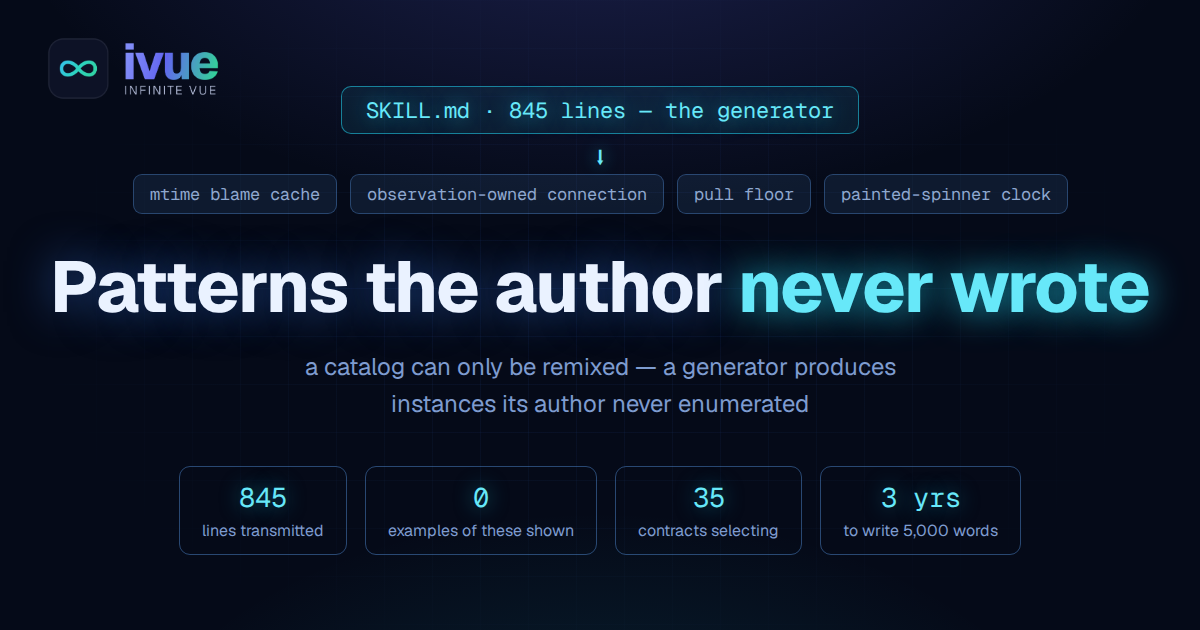
There is a strange admission buried in the Invar story, and it is worth more than all the line counts: the codebase is full of ivue patterns that ivue's author never used by hand.
The blame cache keyed on file mtime. The SQLite connection whose existence is decided by a pane's visibility. The pull floor under the notify channel. The motion heartbeat gated on a spinner inside the painted window. None of these existed in any ivue codebase before agents wrote them. The author of the library — three years into it — had never once expressed them. The agents were not shown these patterns.
They were shown something smaller.
A catalog can only be remixed
Consider what the agents were actually given: the Standard Operating Manual — 845 lines, five thousand words — plus the invariant contracts the fleet accumulates as it works. Not a pattern library. Not a corpus of prior applications. The manual states the model: mutable state is a getter returning a ref; ground truth stays plain; identity is stable; derivations are plain getters; every resource has an owner; closures are pointers and logic lives on the prototype.
Here is the test that distinguishes what kind of document that is. If it were a catalog — twelve examples, imitate them — then everything downstream would be a remix of the twelve. Whatever appeared in Invar would be the author's own usage, echoed at scale. Recognizable. Derivative in the literal sense.
What appeared instead were correct expressions of the model in situations the manual never mentions: git subprocesses, file descriptors, language-server lifecycles, animation clocks. That is the signature of the other kind of document:
A catalog can only be remixed. A generator produces instances its author never enumerated — that is not a bonus property, it is the definition. Theorems the axiom-writer never proved are what axioms are for.
The tell: derivations that need the model, not the examples
One detail proves the difference beyond argument. Invar's LSP client, on disposal, deliberately does not call $stopEffects() — with a comment explaining why: the class owns no watchers, and calling it would clear the cached getter cells and discard the terminal disposed status that later reads must still see.
Trace what that sentence requires. It requires knowing that $stopEffects() clears cached cells — an engine mechanic. It requires noticing this class has no effects to stop — a local fact. And it requires connecting both to subprocess teardown ordering — a domain the ivue docs do not discuss. That three-way combination exists nowhere in the manual, nowhere in the docs, nowhere in the author's own code. You cannot imitate your way to it. You can only reason to it from a model you actually hold.
The components, to be clear, are old engineering — mtime caches, generation counters, debounce floors are classics with decades of prior art, and the agents' training surely contains them all. The derivation is not the classic itself; it is the placement: knowing that in this substrate the mtime cache lives behind a $-cached static getter, publishes through a revision signal, and evicts on the observed set. Old knowledge, correctly threaded through a model the training data had never seen — because the model was months old and one page long.
The chess clause
The person who fixed the rules of chess played a vanishing fraction of the legal games — and that is not a gap in the work. It is the point of rules. Nobody thinks the inventor must demonstrate every combination for the combinations to be real; the rules are finished precisely when the games no longer need their author.
The generator is finished when it produces things its author has never seen. Until then it is documentation. After that it is a substrate.
Three years of reduction compressed a reactive class model into a structure small enough to hand over whole. The fortnight that followed was other minds — stochastic ones — playing games the author never played, inside rules that made the good games easy to find and the bad ones impossible to write. Some of those games were better than any the author had on file. That is not the author being surpassed. That is the reduction working.
The honest half: derivation needs selection
Left alone, this story overclaims, so here is the counterweight. Agents are stochastic rule-followers — they derive wrong things with the same fluency as right ones. The derivations that fill Invar survived because the other half of the system selected them: 39 invariant contracts, AST censuses with positive controls, a merge gate that rejects what the model contradicts. Just this week, a census caught a contract asserting an observation gate the code had lost — drift happens, and the machinery is why it stays small.
So the division of labor is exact. The generator gives direction: which expressions are even candidates. The harness gives selection: which candidates survive contact. Generation without selection drifts; selection without generation has nothing to choose from. The fortnight took both — and the fleet has begun closing the loop itself, minting its own invariants ("a notify channel cannot report its own silence") and validating them across domains the author never connected. The generator is generating generators.
What this asks of your documentation
The transferable lesson is not about ivue. Anyone writing skills, manuals, or conventions for agents is choosing, sentence by sentence, between the two kinds of document. Examples teach imitation; models teach derivation. The test is already available to run on your own docs:
If your agents only ever do what your examples show, you wrote a catalog. If they do things you never showed them — and those things are correct — you wrote a generator.
And none of it is hidden: the manual is 845 lines, the derived patterns sit in the tree cited by file and line, and the contracts that selected them run on every merge. Check any of it.
Three years to write five thousand words. Machines took it from there — to places the five thousand words never went, which is how you know they said something.

Comments