
AI agents built a 26,000-line code editor on ivue
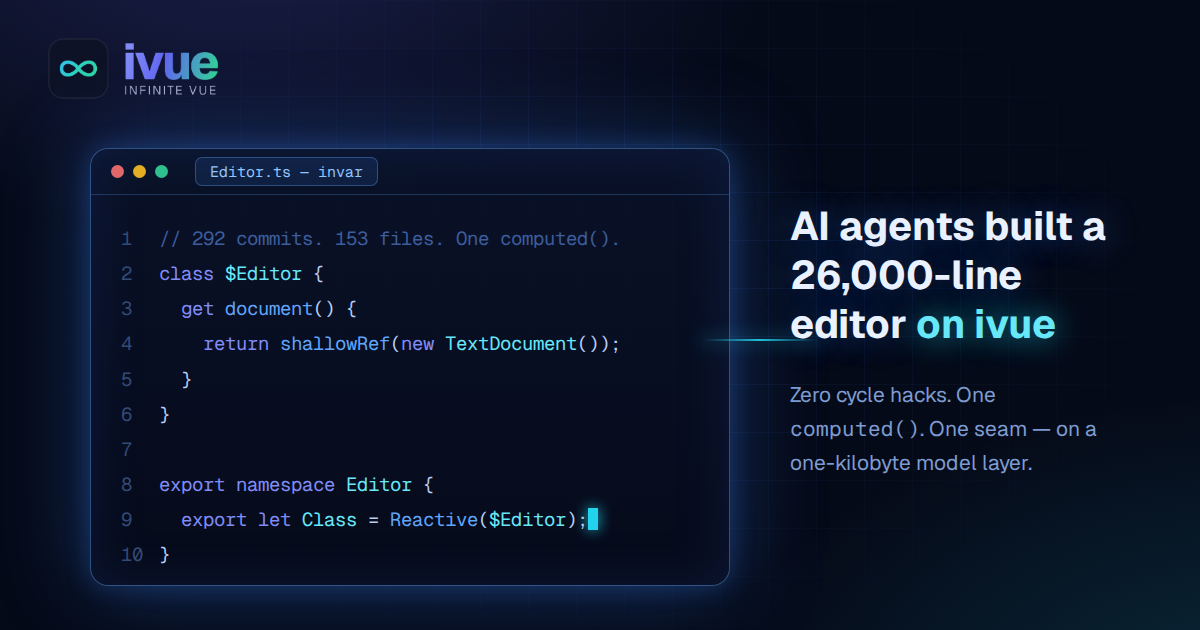
There is a terminal code editor called Invar — named after the iron–nickel alloy engineered in 1896 to have near-zero thermal expansion; precision clocks were built from it because it does not drift. The editor has a file tree, a real text editor with word wrap and emoji-aware columns, fuzzy go-to-file, find & replace, a git panel with side-by-side diffs and staging, LSP hover cards, a command palette, and tabs. It runs on Bun, renders through a terminal framebuffer, and its entire model layer is ivue.
It was built almost entirely by AI agents, in 292 commits. And the measurements it produces are the point of this post.
Counted over the repository (all src/**/*.ts, July 2026): 153 TypeScript files, 25,890 lines including its 57 test files. 42 classes export through Reactive(). 34 stateless capability classes export through Static(). And two counts that would run to dozens in most codebases this size:
- Lazy imports or comment-marked workarounds that exist to break circular dependencies: zero.
- Derivation caches —
computed()calls: one, in the entire editor.
Those numbers are not tidiness. They are the substrate doing work.
No DOM anywhere
First, the quiet result: there is no Vue component, no SFC, and no DOM in this program. ivue drives a terminal — classes hold state in ref-getters, watchers repaint the cells that changed, and Vue's reactivity runs as pure signal machinery under a framebuffer.
ivue was never a component accessory. It is a model layer that happens to plug into Vue templates when templates exist. An editor that ships without a single component is the strongest form of that claim.
The author changed, so the substrate math changed
Almost nobody hand-writes 26,000 lines anymore. The economics of software authorship have shifted to agents — and agents change what a substrate is worth, because agents are stochastic rule-followers. Ask one to follow a convention and it complies at some rate slightly below 100%. Per edit, the gap is negligible. Over hundreds of commits, a per-edit violation rate compounds into a certainty.
That splits every safety property into two kinds:
Discipline-based safety degrades with scale. Construction-based safety doesn't.
A rule that says be careful about import cycles is discipline: it fails stochastically, and a large codebase takes enough edits to make the failure guaranteed. A pattern where the dangerous moment structurally cannot occur is construction: its violation rate is zero no matter how many edits land, because there is nothing to violate.
The wider ecosystem shows what discipline costs at scale. Interactive apps built on coarse-grained re-rendering evolve the same organs under pressure, in public: hand-rolled external stores with selector subscriptions to escape subtree re-renders, hundreds of memoization call sites, and finally a compiler whose job is to automate the memoization. Automating a tax is real progress — but it is not the same as the tax not existing. Fine-grained reactivity — the model Solid.js runs on, the model Svelte 5's runes adopted, the model Vue itself is moving toward with Vapor — has no such tax to automate. In ivue, a ref change re-runs exactly the effects that read it, and a derivation is a plain getter — re-run on tracked reads, costing zero bytes per instance.
That is why the editor contains exactly one computed() in 26,000 lines. Its gutter diff map caches behind computed() because alignment is document-sized work while cursor repaints are frequent — and the call site carries a comment saying precisely that. One cache, opted into surgically, with a written justification; every other derivation in the editor is a plain getter. That is the doctrine — computed() is a cache, not a derivation — surviving contact with a real editor, at a ratio of one to everything else.
Cycles can't happen, so no one fights them
The deeper zero is the circular one. Module cycles are the classic scale disease: Cannot access 'X' before initialization, files created solely to host a constant that two modules both need, lazy imports buried inside functions with a comment explaining which cycle they break. Every one of those artifacts is discipline — a patch applied at one edge of the import graph, by someone who got bitten there.
The namespace pattern removes the disease instead of treating bites. Every cross-module reference is late-bound — getter bodies, method bodies, a Static() seam — so nothing reads another module's value while modules are still initializing. The import graph can contain cycles that never manifest, because binding happens at call time, not load time.
The property is per-edge, and that makes it scale-invariant: it holds identically at 5,000 lines and 500,000, because each reference is still late-bound regardless of how many exist. The editor's git, workspace, editor, and UI modules reference each other freely across 153 files. Chains like workspace → active tab → editor → viewport compose through the graph without a single ordering concern — and the grep for cycle workarounds returns zero, after 292 commits by authors who were never once told to be careful.
For an agent fleet, this is the whole ballgame. An agent that hits a cycle failure burns a session diagnosing initialization order — and every workaround it lands becomes context tax on every future session, which must rediscover the hack, understand why it exists, and preserve it. An invariant that holds by construction costs zero context, forever. The cheapest thing an agent can maintain is a codebase where the failure class isn't in its world.
One seam, applied 34 times
The editor's stateless capabilities — file system access, git commands, parsers, clocks, clipboard, status channels — all export through the same three-line shape:
export namespace Files {
  export const $Class = Static($Files); // anchor — children `extends` this
  export let Class = $Class; // selection — kernels/tests swap this
}Static() binds the class's methods lazily with stable identity, and the mutable Class slot stays replaceable — by a test double, a plugin, a fork — with no dependency-object threading. A human team might debate whether one uniform seam beats a bespoke, explicitly-typed injection shape per subsystem. For an agent the question dissolves: applying one known pattern is the thing it does at the highest fidelity, and 34 identical seams cost less to write, verify, and gate than 34 designed ones. The project enforces the seam with a static-analysis check in its merge gate, so the uniformity is construction too, not habit.
Gates instead of vigilance
The same philosophy runs through how the editor verifies itself. Each module carries a colocated invariants contract — the load-bearing rules of its domain, each stating what becomes impossible if the rule holds. A merge gate verifies them by driving the real user path: injecting input, reading the rendered framebuffer, and blocking any commit that regresses a contract. Not "the agents were careful" — the gate makes carelessness unmergeable.
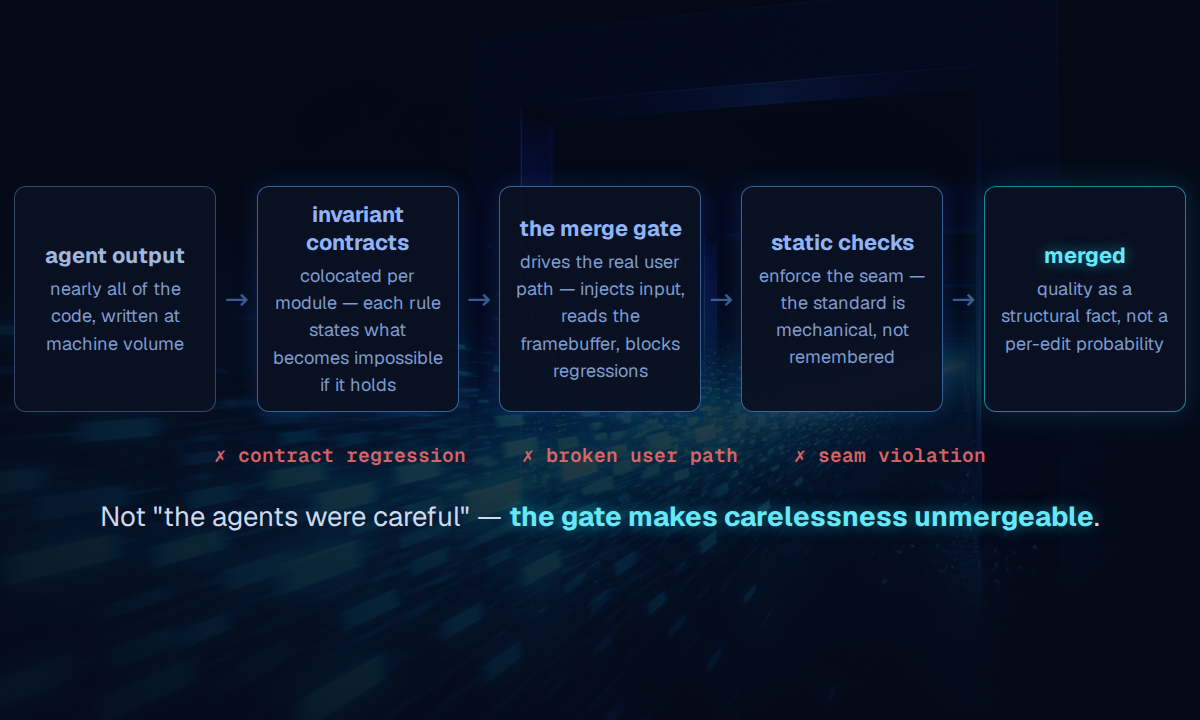
That is one lesson generalized: never trust discipline where you can install construction. Choose substrates where the failure classes are absent, write contracts for what remains, and let gates — not vigilance — hold the line. Agents thrive under exactly this regime, because it converts quality from a per-edit probability into a structural fact.
Where the gate came from
The part no grep can show: the discipline was not installed on day one. The editor is built semi-autonomously — agents write nearly all of the code, and one person steers. The steering has a single, repeated shape: at every decision, push the work toward its invariants — the rules of the domain that hold regardless of implementation, each stated with what becomes impossible if it holds. Out of that repetition the project's structure crystallized: the colocated contracts, then the merge gate that verifies them by driving the real user path, then the static checks that enforce the seam. The agents built their own quality infrastructure, because the guidance kept demanding a standard the infrastructure is the cheapest way to meet.
That is the general recipe this project demonstrates, and none of it is editor-specific. Pick a substrate whose failure classes are absent by construction. State the domain's invariants explicitly. Let agents generate against them, and let gates — not vigilance — hold the line. The human contribution concentrates where it is irreplaceable: knowing which rules are load-bearing. The result here is 25,890 lines with one cache, zero cycle workarounds, and zero apologies — an editor that holds its shape under heat, like the alloy it is named for.
The model layer under all of it is 1.1 kB.
The numbers in this post are measured, not promised: file, line, commit, and call-site counts come from find, wc, git log, and grep over the editor's repository in July 2026 — run them yourself. The reactivity and teardown claims about ivue itself are the engine's documented invariants, verified by its test suite at 100% coverage.
Update — September 2026. The 26,000 lines in the title were true for about nine days. At the 2026-09-03 census the editor measures 173,430 lines of TypeScript — 107,670 of them editor source, the rest its colocated tests — across 384 classes, 39 invariant contracts and 5,131 commits, and every discipline metric held while it grew. The re-measurements are in The editor tripled. The zeros didn't move., and the current census lives on the Invar page.
The story kept going, too: three years of reduction, then a two-week build — what the tempo data says about substrates; patterns the author never wrote — the agents derived designs no human had shown them; and reactivity as an allocator — the editor's backend runs on the same graph that paints it.

Comments