
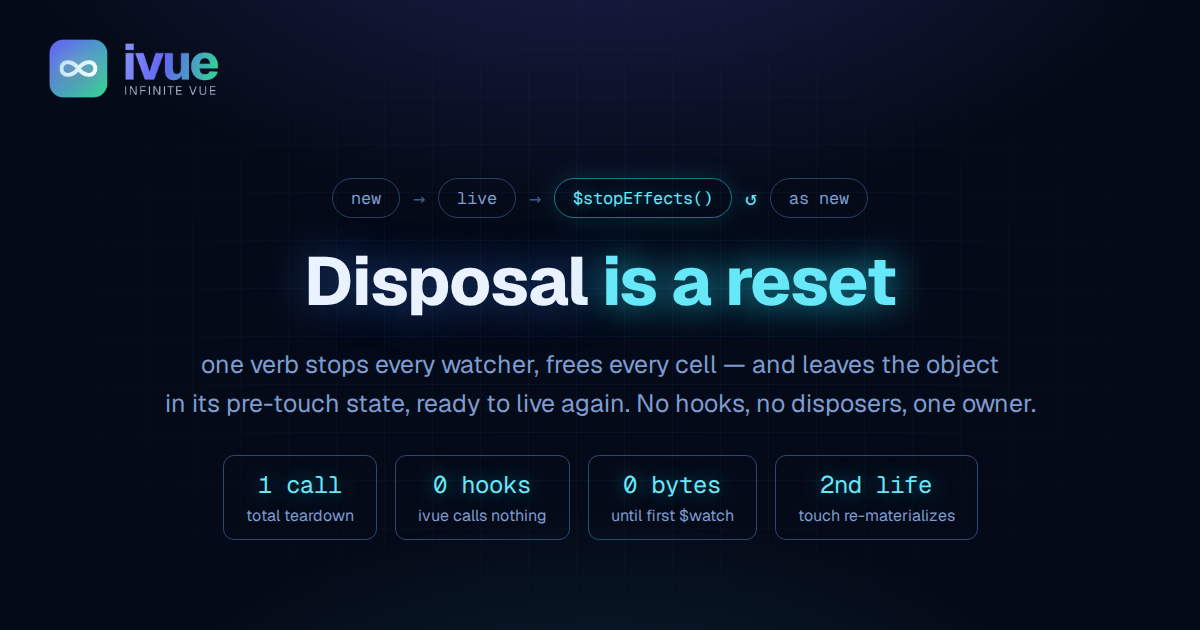
Disposal is a reset
Every reactive system answers birth well. Constructors, factories, setup functions — creation is the polished path. Death is where the answers get vague: disposers you must remember to collect, effects tied to whichever component happened to create them, scopes that leak because nobody owned them.
ivue's answer is one verb on every instance:
session.$stopEffects();It looks like a cleanup call. It is actually three precise operations — and the third one changes what disposal means.
What one call does
It stops the instance's effect scope. Every watcher created through this.$watch / this.$watchEffect lives in a scope the instance owns — detached, so no component's lifecycle can reap it by accident. $stopEffects stops that scope: every watcher dies at once, no disposer bookkeeping, no survivor.
The scope was lazy to begin with. It is allocated on the first$watch — an instance that never watches never has one. The cost of the disposal machinery exists only for instances that created something to dispose.
It frees the cached cells — precisely. Each transformed prototype records exactly which cache keys it may install on an instance; teardown walks the chain child → base and deletes only those. Not a wipe, not a guess — the engine removes exactly what it created, at every level of the inheritance chain, and touches nothing of yours.
The part that changes the meaning
Because the cells are gone, the next read runs the initializers again. Executed, not promised:
class $Counter {
  get count() {
    return ref(0);
  }
}
const Counter = Reactive($Counter);
const counter = new Counter();

counter.count.value = 41;
counter.count.value; // 41

counter.$stopEffects();

counter.count.value; // 0 — the initializer ran againThe instance after $stopEffects is not a corpse. It is the same plain object restored to its pre-touch state — the state it had the moment new returned, before anything materialized. Watch it again and a fresh scope allocates; read a getter and a fresh cell appears; derivations track through the new cells exactly as they did through the old ones. Verified end to end: old watchers stay dead, cell identity changes, a second $watch fires on the new cells.
Disposal and reset are the same operation. The object's death is just its return to the moment before first touch.
That identity is what makes the primitive precise rather than merely thorough. An evicted entity in a long-lived collection can be revived by touching it. A test can recycle one instance through ten scenarios instead of constructing ten. A pool can hand the same object out twice and mean it.
No hooks — on purpose
$stopEffects calls no user code. There is no onDispose, no beforeDestroy, no magic method the engine promises to invoke — ivue auto-calls nothing, at birth or at death. Richer cleanup composes the way everything else in the standard composes: as an ordinary method that does its own work and then calls the verb:
dispose() {
  this.socket.close(); // the non-Vue residue is YOURS to name
  this.$stopEffects();
}A hook is a contract with an invisible caller. A method is a call you can read at the call site. The second one survives refactoring, subclassing, and grep.
When the state should survive
Sometimes the right death is smaller: silence the side effects, keep the data. The verb takes the distinction as an option — $stopEffects({ reset: false }) stops every watcher but clears nothing: cell identity and current values persist, surviving computeds keep evaluating, and a later $watch opens a fresh scope over the same cells. Register watchers in a method the constructor calls, and suspend/resume is two one-liners:
suspend() {
  this.$stopEffects({ reset: false }); // watchers die, state stays
}

resume() {
  this.startWatchers(); // fresh scope, same cells
}Silencing and forgetting are separable acts; the default bundles them because full disposal is the common case — the option unbundles them for the suspend/resume lifecycle.
The ownership rule
The verb exists for instances that outlive components. A component-scoped instance never calls it — plain watch in its constructor lands in the component's scope and unmount reaps it for free. But a module singleton, an entity created in a callback, a model held in a collection — those have no component to die with, so the standard's rule is one sentence: every outliving instance has an owner, and the owner disposes it. When the owner is itself a scope, one line auto-wires the whole thing:
getCurrentScope() && onScopeDispose(() => this.$stopEffects());The same one-owner invariant that governs state and construction in the standard turns out to govern death. Teardown is not a garbage-collection prayer. It is a verb — and someone specific conjugates it.

Comments