
Reactive() and Static() — discovered, not invented
We did not set out to invent a dual.
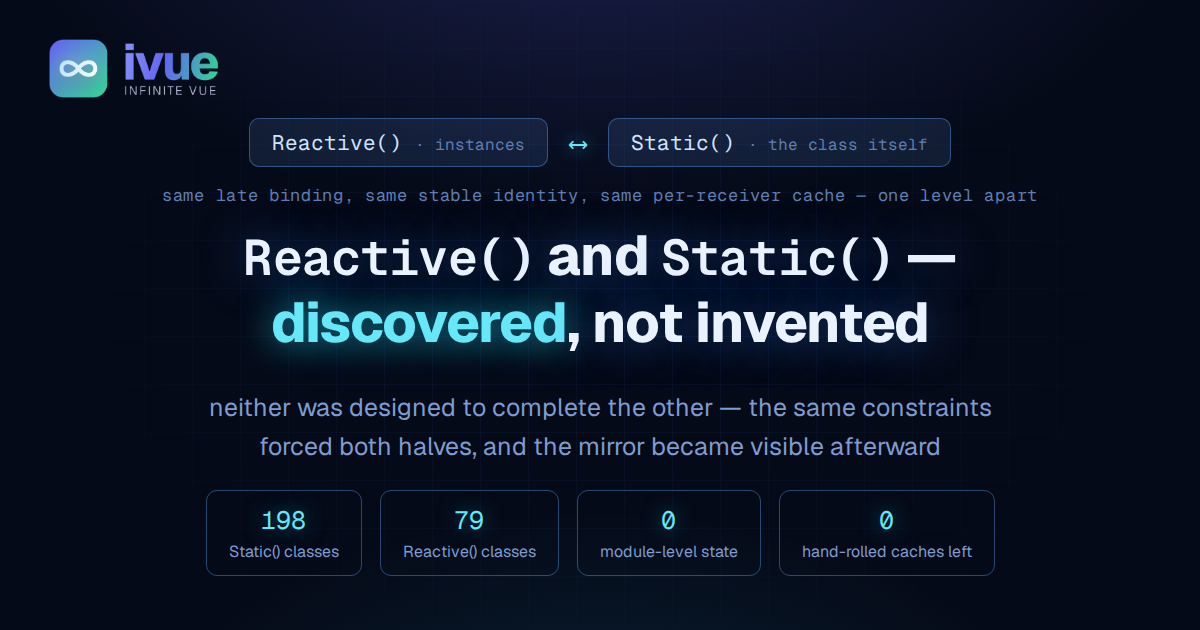
Reactive() and Static() look like a deliberate pair in retrospect: one transform for instances, one for the class object itself; the same late binding, the same stable identity, the same per-receiver cache discipline, applied one level apart. But neither was designed to complete the other. Each was forced into existence by the same pressures, and only afterward did the mirror become visible.
That is usually a good sign. Planned dualities often feel forced. Emergent ones tend to be load-bearing, because both halves were required by the same underlying constraints.
What the pressures were
The original problem was simple and stubborn: we wanted ordinary TypeScript classes — real inheritance, super, private fields, polymorphism — to be fully reactive without paying a cost up front. Earlier attempts at class-based reactivity kept failing in the same places:
- Methods lost their
thisbinding, or produced a new function identity on every access. - Inheritance either collided between parent and child or silently overwrote the parent's behavior.
- Construction allocated every reactive cell whether it was ever used or not.
- Circular imports between modules forced special workarounds.
- Cleaning up watchers and cached state was either missing or relied on hidden framework hooks.
The answer that survived three years of reduction was a single transform applied to the class prototype. Getters that return Vue refs become lazy state: created on first access, then cached. Plain getters stay plain and still participate in reactivity through ordinary dependency tracking. Methods are bound once and keep the same function identity forever. Instances remain ordinary objects — no proxy wrapper. Nothing is created until something actually reads it.
That transform became Reactive().
Separately, the rest of the codebase kept accumulating small, local caching solutions on the static side of classes: module-level maps, lazy singletons, bags of functions that needed to be replaceable in tests, values that should be computed once per class rather than once per instance. Each solution was reasonable on its own. Collectively there were dozens of slightly different answers to the same three questions:
- Compute this value only once.
- Keep a stable identity so the result can be passed around safely.
- Let a subclass override or isolate the behavior in tests.
A single convention collapsed most of them: a static getter whose name starts with $ is computed once per receiving class and cached on that class under a private symbol. Subclasses get their own cache automatically. That convention, together with a small transform that makes static methods lazy-bound and inheritance-safe, became Static().
Only after both existed was it obvious that they were the same idea applied to different receivers.
We did not mean to invent the dual. We meant to stop inventing the caches.
A sublanguage, not a library
By that point the system had stopped feeling like a library you call. A library offers functions and leaves the surrounding discipline to the author. What had actually been built was a small set of structural rules that changed what was cheap, what was expensive, and what was awkward to express:
- Reactive state is declared as a getter that returns a ref.
- Derived values are ordinary getters unless memoization is measurably worth its cost.
- Methods are stable by construction; you pass them as callbacks without extra wrapping.
- References from one module to another resolve when the code first runs, not while modules are still loading.
- A name starting with
$means "compute once per receiver and cache the result." - The class a child
extendsis not the same slot you later swap.
Under those rules, whole families of ad-hoc solutions became unnecessary. A module-level const cache = new Map() stopped looking normal, because ownership, laziness, and test isolation already had a single declaration form. Calling a store or a service inside a field initializer at construction time became suspicious, because a $-getter did the same work later and more safely. Hand-rolled dirty-flag caches for cheap derived values looked like extra state for no gain, because an ordinary getter was already reactive and allocated nothing per instance.
The difference matters. A style guide asks people to be careful. A set of structural rules makes the careless move harder or more expensive. The invariants do not merely document good practice — they remove the conditions that made the old workarounds rational.
Why the dual matters
Once both transforms existed, larger pieces of architecture simplified.

Classes that represent capabilities — filesystem access, subprocesses, terminal handles, native libraries — became Static() collections of methods and $-cached resources. Classes that represent domain entities or view-models became Reactive() instances. Both use the same export shape. Both expose a single replaceable slot for tests and higher-level composition. Both resolve cross-module references at first use, so circular imports between them stopped being a special case.
In the largest system built on this substrate — a terminal IDE of 94,054 source lines — there are 198 Static() classes and 79 Reactive() ones, no module-level mutable variables, and no circular value imports. The dozens of hand-rolled caches are gone. They were symptoms of the earlier constraints. Once the constraints were removed, the caches had no reason to exist.
The dual was never a feature we decided to ship. It was what remained after the constraints had finished eliminating everything that was not required.
Reduction as method
The useful lesson is not that every system needs a pair of transforms named Reactive and Static. It is that certain symmetries only become visible when you stop compensating for the underlying costs and instead eliminate the costs themselves.
- When creating an object is expensive, codebases grow lazy factories and pooling.
- When a method's identity or
thisbinding is unreliable, codebases grow explicit binders, arrow wrappers, and defensive copying. - When inheritance produces collisions or silent overwrites, teams abandon inheritance and rely only on composition.
- When the order in which modules load determines whether a reference is safe, codebases grow deferred-reference helpers, lint rules against cycles, and documentation about import order.
Each of those responses is locally rational. Taken together they become a large framework whose main job is to manage the consequences of the original costs. The other path is to keep asking which of the costs are optional. Make construction essentially free. Make method identity stable by construction. Place behavior on the prototype so inheritance composes instead of colliding. Resolve every cross-module value reference at first use rather than at load time.
What remains is smaller than the sum of the earlier workarounds. And the shapes that survive often mirror each other, because they were forced by the same questions.
The dual was what the invariants left standing.
Both halves live in the Standard; the capability-class half has its own chapter in Static() — Capability Classes.

Comments