
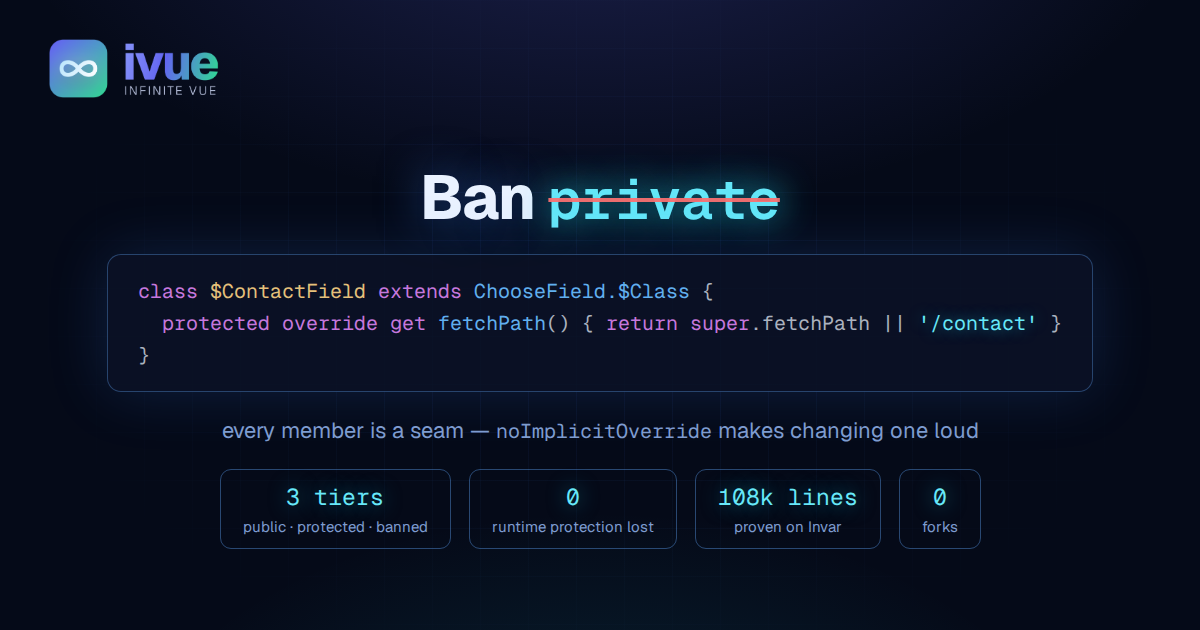
Ban private
You need one line changed inside someone's class:
class $ChooseField {
  private fetchOptions() {
    // 40 lines of tuned fetching — you need line 12 different
  }
}The member is private. Your subclass cannot call it, cannot override it, cannot reach it at all. You have exactly one option left: copy the file. Now there are two files. Every future fix must remember to visit both.
Every
privatemember is a fork waiting to happen.
So the ivue standard bans the keyword. Not "avoid it". Banned. Every internal member is protected, every override says override, and the compiler turns both rules into guarantees. This post is the reasoning, the objection we had to answer, and the codebase that proved it.
What private actually protects
Nothing, at runtime. TypeScript's private is a compile-time annotation. The emitted JavaScript has an ordinary property that anyone can read, write, or monkey-patch. (Native #private fields do hide at runtime. They also hide from subclasses even harder, so they make the problem worse, not better.)
The plain version: private is a sign on a door, not a lock. The only people who obey signs are the polite ones. The polite visitor here is the subclass author trying to extend your work the right way. The keyword forbids exactly the person the architecture exists to serve, and stops nobody else.
That trade might still be worth it in a codebase where inheritance is rare. In ivue it is incoherent. ivue, a 1.1 kB class layer that turns plain TypeScript classes into fine-grained Vue 3 state, exists so that behavior ships once and every variant subclasses it. We wrote a whole post on a production virtual scroller becoming a horizontal card strip and a book-length marquee in eight overridden seams. A private member in that world is a seam somebody welded shut on the way out.
Visibility is a three-tier statement of audience
Once private is gone, the two keywords that remain stop being habit and start carrying meaning. Every member now declares who it is for:
| tier | audience | meaning |
|---|---|---|
public | templates and consumers | the component's surface |
protected | subclasses | a seam of the hierarchy |
private | nobody | banned |
The middle tier does real work. A protected member is reachable from every subclass and invisible to everything else. TypeScript refuses access from templates, from other modules, from consumers. So the keyword now answers a design question at a glance: public is what the component promises the outside world, protected is what the family line can tune. There is no third audience, so there is no third keyword.
And if a member feels like it must be hidden even from subclasses, that feeling is the finding. It usually means the member has a misleading name, an undocumented invariant, or a shape that would break if touched. The fix is to name it properly and state the invariant — not to lock the door and hope no one needs the room.
The objection: "now every rename is a breaking change"
This is the real argument for private, and it deserves a real answer. If everything is protected, then every internal member is part of the extension surface. Rename one, and some subclass somewhere silently loses its override. The method still compiles. It just never runs again. That fear is legitimate. Silent orphaning is worse than forking.
The answer is one compiler flag:
{ "noImplicitOverride": true }With it on, every member that overrides a base member must say so:
class $ContactField extends ChooseField.$Class {
  protected override get fetchPath() {
    return super.fetchPath || '/contact';
  }
}Now rename fetchPath in the base, and every subclass breaks at compile time, at the exact member, with an error that names it. Seam drift is loud. Nothing orphans silently.
The plain version: protected opens every door, and override puts an alarm on each one. Open doors without alarms are fragile. Alarms without open doors are forks. You need both, and both are one line of config plus one keyword the compiler forces you to write anyway.
That is the whole doctrine. Two rules, each covering the other's weakness:
protectedmakes every seam reachable.noImplicitOverridemakes changing one loud.
Where it was proven
Invar is a 108,000-line terminal IDE built almost entirely by AI agents on ivue classes. Its house standard was stricter than ivue's: Invar banned private first. The ban migrated upstream into the ivue standard after we watched it hold.
Agents made the case sharper than humans ever did. A human who hits a private wall might file an issue, or grumble and work around it. An agent extends or it copies. There is no negotiation step. Across tens of thousands of agent-written lines, every member being a reachable, override-guarded seam is a large part of why the codebase grew by subclassing instead of by duplication. The gate-driven build caught seam drift the same hour it happened, because seam drift is a compile error.
The docs site you are reading eats the same cooking. Its behavioral components are ivue classes under the same rule: the newsletter card, the delivery strip on the home page. When the rule landed, migrating them was a mechanical sweep: private became protected, the build stayed green, and every one of those components became extensible in the same commit.
The invariant
Encapsulation was never the goal. It was a proxy for a goal, "do not couple to my internals by accident", enforced with a tool that also forbids coupling to them on purpose. Split the two apart and the proxy dissolves: templates and consumers are kept out by protected itself, and deliberate extension is guarded by override.
A class is a promise that behavior can be built upon. private is the one keyword that breaks the promise selectively, for the politest visitor, at zero runtime benefit. Ban it, alarm the seams, and the next person who needs line 12 different writes three lines instead of copying forty.

Comments