
The Options API everyone actually wanted
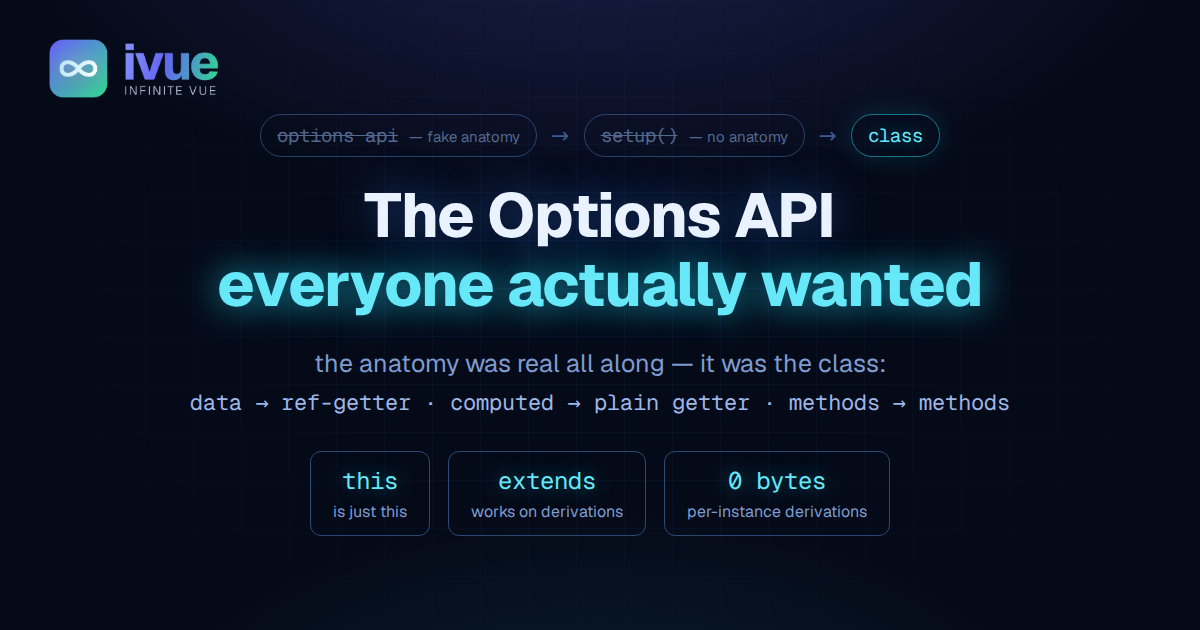
What people loved about the Options API was never the data / computed / methods buckets themselves. It was that a component had anatomy. You could open a stranger's file and know where the state lived, where the derivations lived, where the actions lived — before reading a single line of logic.
What killed it was that the anatomy was fake: a plain-object DSL pretending to be a class. this was a runtime proxy TypeScript fought for years. One logical concern got shredded across three buckets. Reuse meant mixins — shallow option merging, name collisions, properties appearing on this from files you'd never opened. And none of it existed outside a component: the "class" had no instances you could hold, test, or share.
The Composition API fixed reuse and typing by giving up the anatomy. setup() is honest — plain functions, real closures — but it comes with no shape at all, and setup-soup is the scar tissue: every team reinvents its own ordering conventions because the structure the Options API promised is gone again.
ivue's observation is that the anatomy everyone wanted was sitting in the language the whole time. The class is the Options API with the pretending removed — every bucket comes back as a member kind, and every fake guarantee becomes a real one:
export default {
  data() {
    return { count: 0 };
  },
  computed: {
    double() {
      return this.count * 2; // `this` is a proxy; typing it took years
    },
  },
  methods: {
    increment() {
      this.count++;
    },
  },
};// counter.ts
import { Reactive } from 'ivue';
import { ref } from 'vue';
class $Counter {
// data → a getter returning ref(); read and write via .value
get count() {
return ref(0);
}
// computed → a PLAIN getter: reactive via leaf tracking, zero
// bytes per instance — no computed() unless the work is expensive
get double() {
return this.count.value * 2;
}
// methods → methods; the engine binds them lazily on the prototype
increment() {
this.count.value++;
}
}
export namespace Counter {
export const $Class = $Counter; // raw — children `extends` this
export const Class = Reactive($Class); // reactive — you `new` this
export type Instance = typeof Class.Instance; // defineExpose type & reactive() interop
}Same anatomy, real substrate. And the substrate is where "beyond it" stops being a slogan:
thisis justthis. Native TypeScript, no proxy gymnastics, noThisTypemachinery. Methods pass safely because the engine binds them lazily, once, with stable identity.- Derivations participate in inheritance. A computed is a getter, and getters understand
extendsandsuper— subclass a store and override one derivation. The Options API had mixins; it never had this. - The buckets cost nothing. An Options API component allocates its computed watchers per instance. An ivue plain getter lives on the prototype: zero bytes per instance, reactive through the leaves it reads. The admin dashboard in ivue's own repository runs eleven models and a router-backed store on zero
computed()calls — the surgical opt-in simply never earns its ~300 bytes there. - Instances exist outside components. The same class conventions run ivue.dev's newsletter Worker — schedulers, delivery, an OAuth signer — with no component in sight. The Options API's anatomy was component-bound; a class is just an object you can
new, hold, test, and pass anywhere.
The scope claim, once and honestly: ivue does not replace the Composition API — it is built on it. ref(), watch(), lifecycle hooks, any composable — they all work inside the constructor, which runs synchronously in setup context. The Composition API is the machinery; the class is the missing structure.
So the lineage reads cleanly: the Options API promised anatomy and faked it. The Composition API delivered honest machinery and dropped the anatomy. The class keeps both promises at once — which is why it feels less like a third paradigm and more like the one everyone was asking for the whole time.
Start with the shape itself: The Standard.

Comments