
Fix the scroller, never open the selection
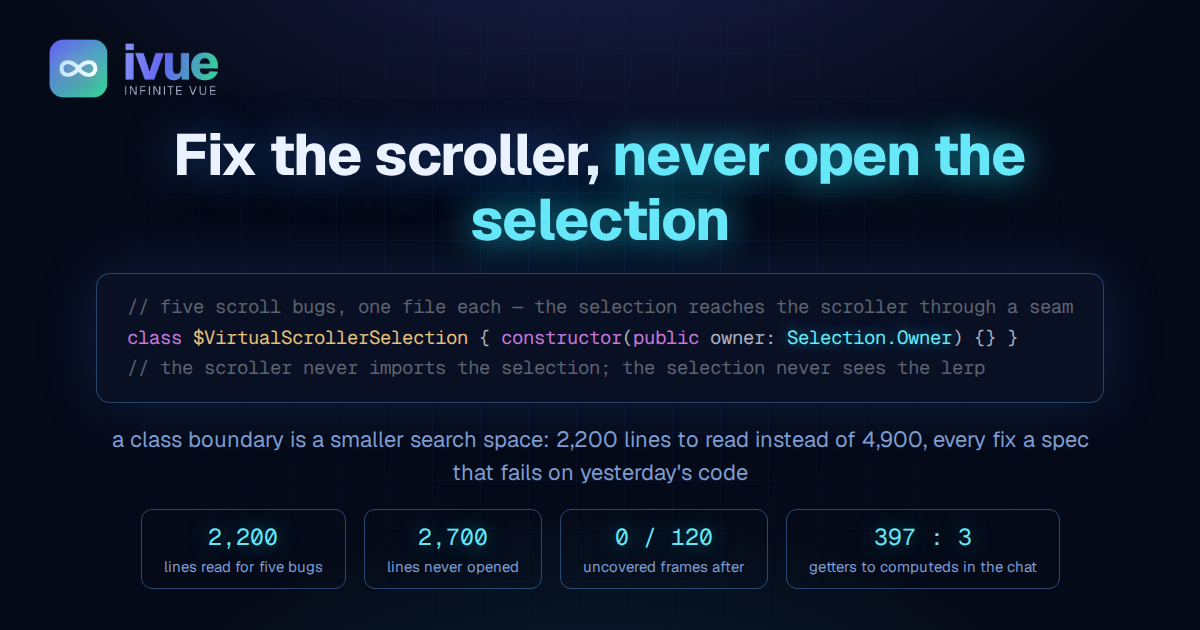
Five scrolling bugs surfaced in one session on the chat example: a frame loop that never stopped, a glide that never finished, a viewport left past the last row, a blank strip at the bottom of a long scroll up, and one frame where the rows landed 63,000 pixels away. Every one of them was a one-line relation. Every one of them lived in the same 2,200-line file. And that file sits beside 2,700 lines of selection, touch and padding code that I never opened to find any of them.
That is the whole post. The rest is the receipts.
A class boundary is a smaller search space.
The size of the thing
The virtual scroller in the ivue playground is five classes, each an ivue class, a plain class $X published through a namespace. ivue is a 1.1 kB layer over Vue's reactivity that turns such a class into a reactive model once, at load, and leaves the instances as plain objects.
| file | lines | owns |
|---|---|---|
VirtualScroller.ts | 2,200 | the window, the lerp, the spacers, the scrollbar |
VirtualScrollerSelection.ts | 1,558 | a selection as a range over the data |
VirtualScrollerSelectionTouch.ts | 735 | the long press, the handles, the copy chip |
VirtualScrollerPadding.ts | 265 | the pad around the window |
HorizontalVirtualScroller.ts | 128 | the other axis, through seam getters |
The selection alone is nearly the size of the scroller. Packed into one class this would be a 4,900-line scroller, and the two most common edits in it, a scroll fix and a selection fix, would share a file and a scroll position.
They do not share a file because the selection reaches the scroller through an owner interface, a few getters and methods the scroller promises, and nothing else. The scroller does not import the selection's class. The selection cannot see the scroller's lerp. That is a rule in the scroller's invariants file with a spec bound to it, so it cannot drift.
Said plainly: the selection knows the scroller's front door, not its rooms.
Five bugs, one file
Each fix below is a spec now, and each spec fails on the code before it.
The loop that never stopped. A scroller nobody touched should cost no frames. Counting requestAnimationFrame per second on the chat page: 0 before the first wheel, 60 during the glide, and 60 forever after. The loop only parked itself in the autoplay path. It parks at rest now, and the next input wakes it. Measured after: 0, 60, 0.
The glide that never finished. The parking depended on Lenis saying it was at rest, and it never did. Its lerp completed only when Math.round(value) === target, and a target that had been shifted by a fraction of a pixel, a rebased offset does that, could never round onto. The animation ran forever at a velocity of a millionth of a pixel. It completes within half a pixel of any target now.
The viewport past the last row. After a row resizes, the scroller re-measures and restores the anchor row, the row under the reading edge, so nothing above the reader jumps. That restore moves the position by what changed above the anchor. When the last row shrinks, a streaming reply whose partial markdown was taller than its final render, or a tall card folded at the end, nothing above changes, so nothing re-clamped, and the viewport rested on empty canvas below the last row. A clamp runs after every re-measure now.
The blank strip on a long scroll up. The window walks from the lerp's target, and the reader sees the animated position some hundreds of pixels behind it. The rows between were padded as gap divided by the estimated row size. Here the rows behind measured 35 to 86 pixels against a 160 pixel estimate, so four rows covered a fraction of a 504 pixel gap, and the bottom 243 pixels went blank. The walk extends in pixels over the measured sizes now.
The frame 63,000 pixels away. Rendered offsets are rebased by whole chunks of 65,536 pixels so the compositor never sees a large number. The loop rebased from the animated scroll, then its target write rebased again from the target. When the two straddled a chunk boundary the bias flipped mid-frame: the spacer took the new bias, the transform kept the old. A position write that does not write the transform never rebases now.
The last two were found with a probe that wheels up 120 times and samples whether mounted rows cover the viewport. Before: three uncovered frames. After: none.
| probe, 120 wheel ticks up | before | after |
|---|---|---|
| frames with the bottom uncovered | 2 (150 and 243 px) | 0 |
| frames with the rows a chunk off | 1 (63,387 px) | 0 |
| frames per second at rest | 60 | 0 |
Why the file size was the finding
None of those five bugs was about ivue. They were about virtual scrolling under a lerp, and no class layer changes the physics. What the layer changed was where I had to look.
A one-line relation in 2,200 lines that are all about the same thing is a bisect: sample the viewport, revert the file to yesterday, sample again, read the loop. A one-line relation in 4,900 lines where the same file also owns pointer capture and long-press timing is an afternoon of reading code that cannot be the cause. I made that check once during the session, by reverting only the scroller and Lenis files to the commit before the day's changes and running the probe again. Same three frames. The bugs were old. The check took one command because the files were the boundary.
The boundary held under pressure because the standard makes it the cheap option, not the disciplined one. A capability is a class with an owner interface. A seam is a getter. A section of a component is a role on a kit. None of those cost anything at runtime, so there is never a moment where merging things would be faster. Correctness came from the right shape being the easy shape.
The same shape on the other side
The chat that runs on this scroller was built the same way in the same session, and it kept the count I care about most. The whole chat, the thread, the index, the files panel with its diffs, the scrollbar peek, the model picker, the settings, derives everything through plain getters. The count as of the last commit:
| kind | count |
|---|---|
| plain getters | 397 |
computed() | 3 |
All three computeds are the same forced case, a list handed to a virtual scroller whose identity must be stable per filter state. Everything else is a getter on a prototype, which costs zero bytes per instance and is why a message row is a small object and not a small heap. That is also why the code reads clean: there is nowhere for state plumbing to accumulate, so what is left on the page is the domain.
Every feature added that day landed as a getter, a method, or an entry on a seam. The scrollbar peek is a role on the chat's kit. The model picker is a role on the composer's. The files panel's records are rows of its own scroller. None of them touched a sibling. The pattern is written up in Infinite malleability; the selection's own design is in Select text across a million rows.
What to take
If a bug hunt makes you read code that cannot be the cause, the boundary is in the wrong place. Move it to the concern, give the capability an owner interface, and bind the rule to a spec so it stays there. Then the next hunt is a bisect.
The class boundary is the search space.

Comments