
The field, not the rules
There are two ways to get good code out of a codebase.
The first is rules: style guides, review checklists, lint warnings, onboarding docs. Rules assume the bad moves stay available and ask everyone, politely and forever, not to make them. Every rule is a standing tax — it must be taught, remembered, enforced, and re-litigated in every code review until the end of the project. Rules police a space that remains dangerous.
The second is the field: change what can be expressed, so the bad moves stop existing as moves. Nobody reviews for the mistake because the mistake has no syntax. Nobody remembers the discipline because there is nothing to remember — the shortest path and the correct path are the same path.
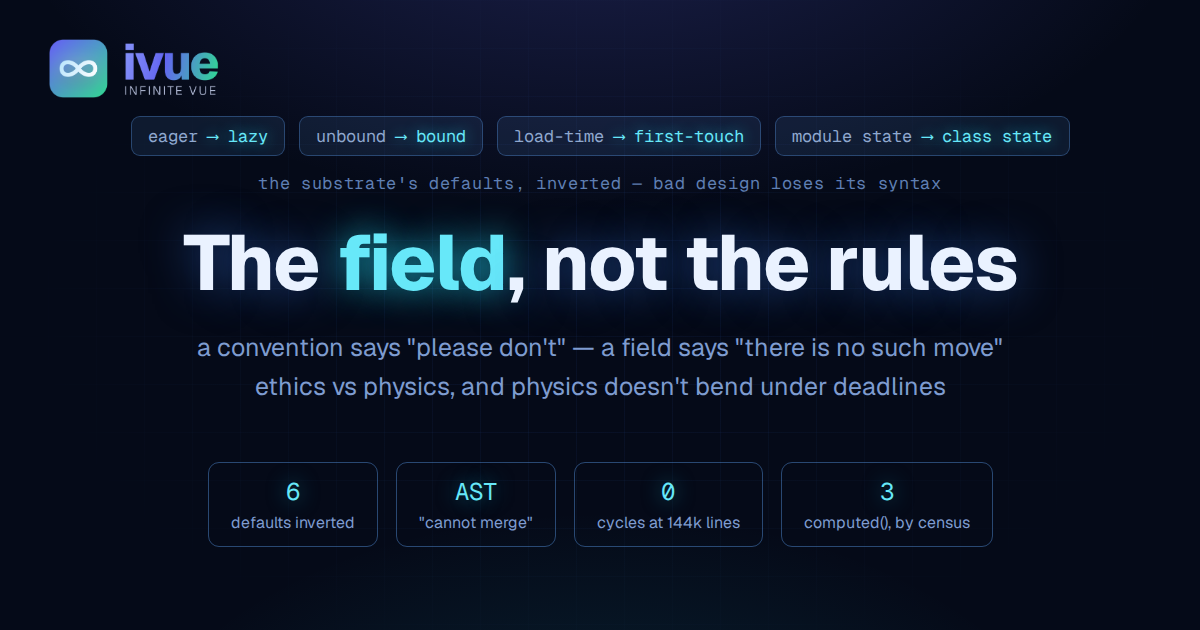
A convention says "please don't." A field says "there is no such move." The first is ethics. The second is physics.

ivue started as a reactivity engine. What it turned into — together with the invariants built around it — is a field change: a deliberate reshaping of JavaScript's possibility space, flipping the substrate's defaults one by one until sound design became the path of least resistance.
The inversion table
Each row is one default of stock JavaScript, inverted:
| stock JavaScript defaults to… | the reshaped field defaults to… |
|---|---|
| eager evaluation at module load | nothing exists until first access |
unbound methods — this is the caller's problem | bound methods, stable identity |
| references resolve at import time | references resolve at first touch |
| module-level state as the path of least resistance | state has no legal home outside a class |
| import cycles as runtime landmines | cycles structurally inert |
| caching manual, ad-hoc, everywhere | caching a rare, census-able annotation |
None of these is a rule someone follows. Each is what the code does when nobody is trying. A ref-getter cannot allocate before first read — laziness is not a discipline, it is the mechanism. An ivue method arrives bound because the engine binds it at the prototype — passing box.grow as a handler simply works, and the entire class of this-loss bugs becomes unwritable. A cross-module reference inside a method body resolves when the method runs — long after every module has loaded — so the oldest structural wound in JavaScript closes not because anyone is careful but because load-time reads stopped being expressible.
Enforcement is what makes it a field
Inside Invar — the terminal IDE that AI agents built on ivue — the inversions are not aspirational. They are gated by AST checks that run with the test suite: no eager module-level const holding state, no loose functions floating outside classes, no load-time reads across modules. Everything lives inside classes; everything defers; everything loads on demand.
That gate is the line between a style and a field. A style guide bends under deadline pressure — one exception, then five, then the guide is archaeology. An AST check does not bend. Code that expresses the old defaults doesn't get merged, so the field's curvature holds at 144,000 lines exactly as it held at ten.
Constraints you must remember will eventually be forgotten. Constraints built into the field cannot be.
The census numbers are what holding looks like: 372 files in a deeply cyclic domain, zero value-import cycles, zero forwardRef-style workarounds, zero load-order rules. Across the editor's reactive core, three computed() calls — each one a deliberate, documented purchase. Not because agents were disciplined. Because the alternatives were not reachable.
Removing expressiveness — where it was useless
"Less expressive" sounds like a loss. Look at what was actually removed:
- The ability to read another module's value before loading finished.
- The ability to scatter mutable state across module scope.
- The ability to pass a method and silently lose its
this. - The ability to allocate reactive machinery for values nobody reads.
Every one of these is degenerate freedom — a way to say something that was never worth saying. No feature was lost; a class of regrets was. What remains is a smaller language that can express everything the domain needs and nothing it apologizes for. The same subtraction that took the engine to 98 lines, applied one level up — to the possibility space itself.
This is an old idea wearing new tools. Type systems made illegal states unrepresentable in data. The field makes illegal designs unrepresentable in architecture — load order, binding, state placement, cache policy — the layer where projects actually rot.
Why agents thrive on it
The strangest evidence came from watching the fleet work. Agents produced patterns the author never wrote — capability classes, reactive control planes, structures no example ever showed them. That is not obedience. Obedience reproduces the training examples; it does not exceed them.
The explanation is the field. An agent exploring a rule-based codebase must model the rules and the ways they bend — its search space is full of moves that compile today and rot tomorrow. An agent exploring a constrained field can search aggressively, because every reachable point is structurally sound. Constrain the space and exploration becomes safe; make exploration safe and you get emergence instead of entropy.
Rules cap how bad the code can get. A field raises how good it can get — by making the search space safe to explore at full speed.
That inversion — constraints as an accelerant, not a brake — is the part worth sitting with. The AI-era argument usually stops at "agents need guardrails." The field goes further: agents need a geometry, and given one, they build things their operators didn't specify and couldn't have. The proof is not a claim about the future. It is running software.
The claim, plainly
We did not write better JavaScript. We changed what JavaScript defaults to — evaluation time, binding, state placement, resolution order — and then removed the expressiveness that only ever produced regret. The game plays differently because the board is shaped differently.
Rules are what you need when the field is wrong. Fix the field, and the rules dissolve into it — unenforced, unremembered, and unbroken.
Start with What is ivue?, see the defaults up close in the Standard, or read what this field made buildable.

Comments