
One question deleted 537 lines
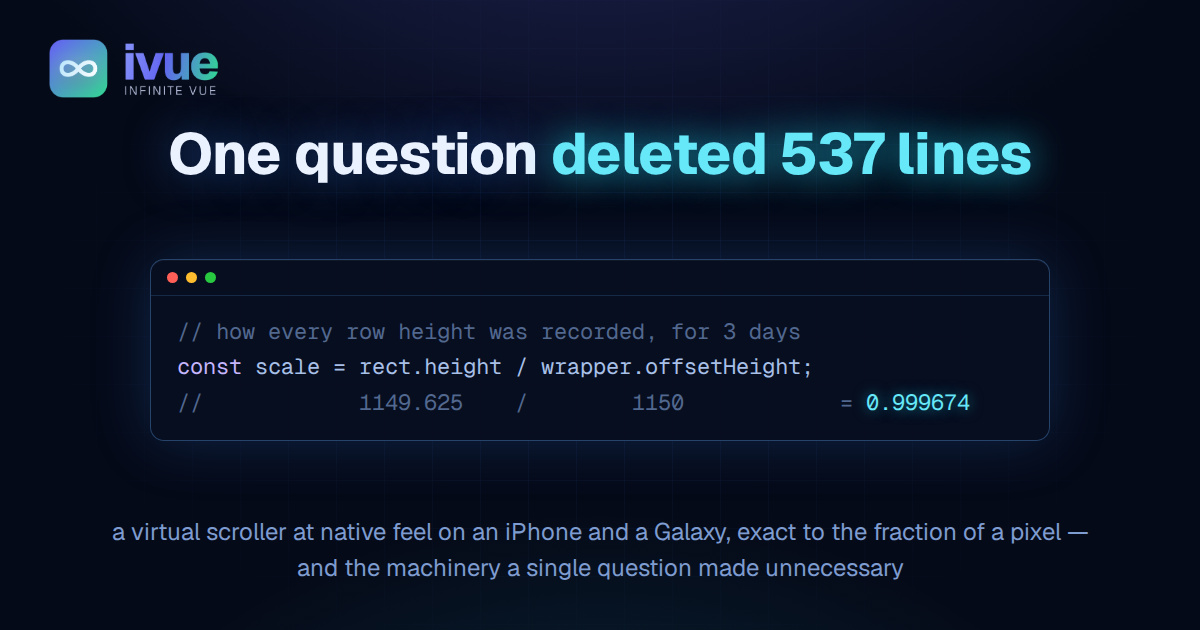
// how every row height was recorded, for 3 days
const scale = rect.height / wrapper.offsetHeight; // 1149.625 / 1150 = 0.999674
1 line. A fraction divided by a whole number. It made a virtual scroller record every row 0.03 to 0.06 px taller than the browser drew it. It cost 3 days, 4 reverted mechanisms and a settings knob with 3 positions before anyone asked the question that made it visible.
I want to tell this one in order, because the order is the lesson.
What we were trying to do
ivue, a 1.1 kB class layer over Vue's reactivity, ships a virtual scroller. It holds a million rows in 12 divs. The rows you can see are real DOM. The rest is 2 empty elements sized by arithmetic. The browser does not scroll it. A small scroll engine computes a position every frame and writes it as a translateY on the strip of live rows.
That is the whole difficulty. A browser scrolls on its own thread and never asks the page for anything. A virtual list scrolls on the main thread. It has to mount rows before you reach them, and it has to measure each one after it appears, because a chat message is as tall as its text. The goal: a reader on a phone cannot tell the difference.
The thread below is the test bed: the AI chat example, built with the Infinite Malleability Kit. It is a real Claude Code session with 10,350 messages. Every message is a row. Content is fetched a page at a time as the window reaches it. Scroll it on a phone.
The symptom
On an Android phone, after a flick came to rest, a line of text would drop 1 pixel. Not the whole screen. 1 line, sometimes 2, 1 pixel up or down, about every other scroll. On the iPhone beside it, nothing.
Small enough to doubt. Real enough to see on demand once you knew where to look.
3 days of the wrong question
The question on the table was: what is the browser doing with the fraction? I was working this with an AI agent, and that was the agent's question. It was a good one. It was also the wrong one, and for 3 days I did not stop it.
The scroller writes fractional positions, like translateY(-107293.6458px). To move a drawn layer by a fraction of a pixel, the browser has to resample it. Chrome also snaps each line of text to whole device pixels when it draws, and 2 neighbouring tiles drawn at different fractions can disagree. That is a true story about browsers. It explained the symptom completely. So we built around it.
We added a snap setting at the write. grid rounds every position to the device pixel. fractional never rounds. auto rounds only when the content moves more than 1 device pixel per frame. A knob to choose. A row of buttons in the docs to feel the difference on the device. Probe numbers that said fractional was the expensive one.
Then we measured, because the knob did not remove the line shift. Every frame of a glide, recorded at the source. We caught the moment the glide came to rest: a half-pixel jump onto the grid with nothing else moving, a rule the agent had added that same morning, reverted. We tried a claim that fresh tiles were the trigger, so the 2 frames after any window change took the grid: built, measured, fixed nothing, reverted. We found that releasing spare rows at rest moved every remaining row by exactly 3/64 px, so we moved the release to the next moving frame, where nothing can be seen: shipped, and it stopped the iPhone from unloading rows. Reverted.
Every one of those was reasoned. Every one had a measurement behind it. Every one was about the costume.
The question
"Don't you already know the heights? Why is there a 3/64 px diff at all?"
That was me. Not the tracing, not the per-frame capture, not the agent with 3 days of numbers. I had no instrument at all, only the thought that we were arguing about the browser's rounding while our own model claimed to know the heights. The scroller records each row's height when it mounts. So the model knows to the pixel what the spacers should be. If the model knows the heights, releasing rows into a spacer should move nothing. The leftover was not the browser rounding. It was the model disagreeing with the browser about the heights.
5 rows, 1 getBoundingClientRect, 30 seconds:
row       drawn       recorded    error
10343     191.3750    191.4374    +0.062
10344     149.1875    149.2362    +0.049
10345     102.5000    102.5334    +0.033
10346 169.9063 169.9617 +0.055Every drawn height is an exact multiple of 1/64 px. That is how Chrome's layout engine counts. Every recorded height is not. The difference is the line at the top of this post. The scroller divides each measured height by a "wrapper scale" meant to undo a CSS transform on a parent. That scale is the wrapper's fractional height over its offsetHeight, which is a whole number. A wrapper 1149.625 px tall reads as scaled by 0.999674. Every row in the wave gets divided by it.
In plain words: the ruler was off by a hair. Every measurement made with it was off by the same hair. Fold 3 mis-measured rows back into a spacer and the spacer is 3 hairs too tall. The content below moves by 3 hairs. That is 3/64 px. Nobody can see 3/64 px move. What they see is the redraw that follows. It snaps each line of text to the grid from a new position. The lines that sat near a boundary hop. The rest do not.
The fix is 4 lines. A transform moves the wrapper by many pixels. Rounding moves it by at most half of one. Under 1 px of difference, the scale is 1.
What fell out
Recorded heights now equal drawn heights on every row: off: 0. The same release of 4 spare rows at rest moves 0 remaining rows. Both phones tested by hand: no line shifts, on either, in any setting.
Then the part that makes this a story about reasoning and not a bug fix. With the heights exact, fractional had no downside left. The thing the snap knob existed to hide had been the height error the whole time. Rows "whose tops carry different fractions" were rows recorded a hair off, moving against their neighbours at every window change. So out went the knob, its 3 modes, the landing snap, the extra argument every position write in the codebase had carried, the row of buttons, and the plain-browser comparison chat we had mounted under the example to judge against. 537 lines out, 50 in, across 13 files. The scroller behaves the same.
The scaffolding was a monument to the costume.
What it feels like now
The same flick on both devices, judged by hand against the browser's own scrolling. Positions are written to the fraction and never rounded on the way from the model to the layer. (2 days later that last clause turned out to be half right: the model keeps the fraction, and the write now lands on the device-pixel grid. The snap I deleted here had been tested in the 1 regime where it cannot show. The story continues in 99.7% and 100% are worlds apart.) 2 knobs stayed, because they turned out to be about the phones and not about the bug. How far a flick carries: the browser's own fling measures at about 16 frames of the finger's speed; the scroller ships 35 and offers both. How a flick comes to rest: an exponential ease feels like an iPhone, a constant-friction stop feels like Android. Both are live in the strip above the thread.
The numbers that survived. The DOM holds a few dozen rows of a 10,350-message thread. The recorded height of every row matches layout to 1/64 px. On both phones the scroller is indistinguishable from native by the only instrument that counts for that claim, which is a thumb.
The shape of it
Every instrument was pointed at the browser. Tracing. Per-frame capture. A PNG decoder written to measure glyph edges at sub-pixel offsets. A synthetic page to isolate line-height rounding. All of it measured the costume, with great precision.
None of it asked whether our own numbers were true.
That is the whole lesson, and it is older than software. Before you ask what the world is doing, ask what you are claiming to know about it. Do we know the heights? We did not. We had a ruler with a hair missing and 3 days of careful reasoning about what the hair was doing to the browser.
The right question is not clever. It points at the thing you already believe. It costs nothing to ask. This one deleted 537 lines.
This is the way of working that produced ivue and keeps shrinking it. Ask what must be true. Delete what reality does not require. Keep what survives. It made a 1.1 kB engine. Here it made 3 days of machinery vanish before lunch. It is coming as its own thing, and it is bigger than the library.
A mechanism that hides an observation is hiding a mistake of yours. Check the ruler before you argue about the world.

Comments