
Pause the watchers, keep the state
Disposal is a reset told the story of $stopEffects(): one verb that stops an instance's watchers, frees its cells, and leaves the object in its pre-touch state, ready to live again. Full death, cleanly conjugated.
But writing it down exposed a bundling. The verb performs two acts — silencing (stop the effects) and forgetting (clear the state) — and nothing says they must travel together. Sometimes the right death is smaller: an entity leaves the visible world but keeps its data; a feed pauses its rendering while its buffer stays warm; a model is archived mid-thought and must wake up exactly where it stopped. Silence, without forgetting.
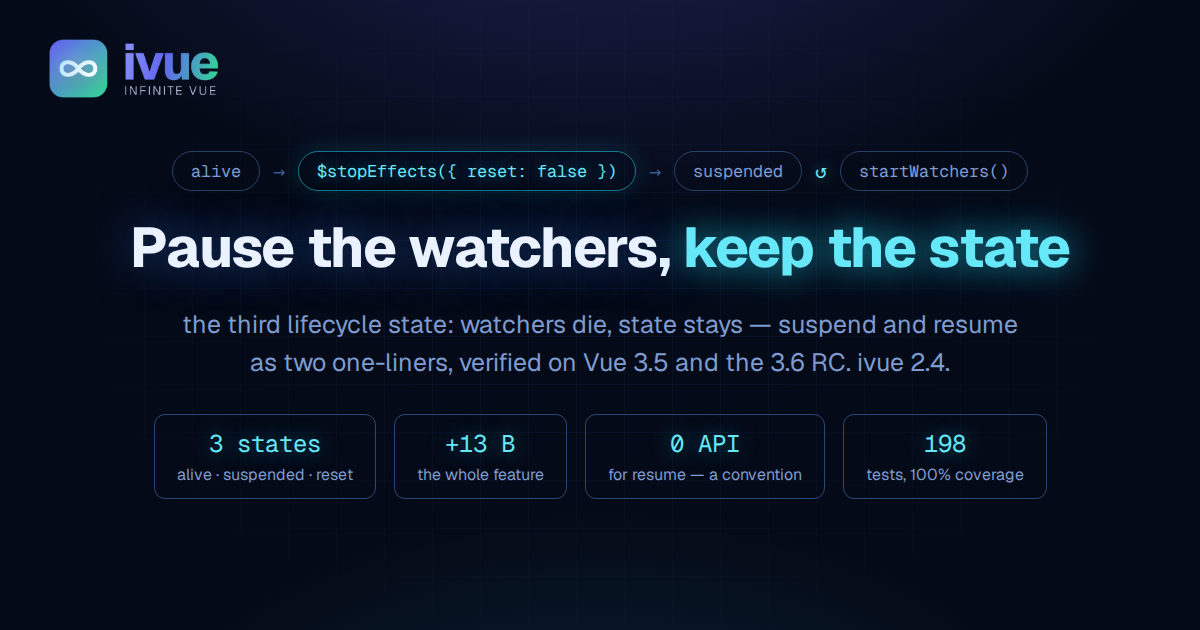
ivue 2.4.0 unbundles them, as one option on the verb that already existed:
session.$stopEffects();                 // stop + forget (unchanged)
session.$stopEffects({ reset: false }); // stop the watchers ONLYWith { reset: false } every watcher dies at once — same scope, same precision — but no cache is touched. Cell identity persists, current values persist, and surviving computeds keep evaluating.
The part that had to be checked
That last claim was the design's one real hazard. Cells materialize in whatever effect scope is active at first touch — so a computed() first read inside the instance's own $watchEffect is born inside the scope being stopped. If stopped scopes dragged their computeds into permanent staleness, keep-state mode would be a silent-corruption factory.
Measured instead of assumed: on Vue 3.5.41 and on 3.6.0-rc.5 — the alien-signals rewrite, where exactly this machinery changed — a computed born in a stopped scope keeps evaluating correctly on read, and a new watcher in a fresh scope tracks it and fires. Pull-based derivations outlive their birth scope. The option is safe on both engines, verified before it shipped.
Resume costs no API
The resume half of the lifecycle needed no engine surface at all — only a convention the standard now teaches: watchers live behind a startWatchers() method, and the constructor calls it once.
class $Feed {
  constructor() {
    this.startWatchers();
  }

  startWatchers() {
    this.$watchEffect(() => this.render());
  }

  suspend() {
    this.$stopEffects({ reset: false }); // watchers die, state stays
  }

  resume() {
    this.startWatchers(); // fresh scope, same cells
  }

  render() {
    /* ... */
  }
}resume() is just startWatchers() again — the same method the constructor already used, now running in a fresh lazy scope over the same cells. One option flag plus one convention, and the whole suspend/resume lifecycle exists. Nothing was designed for it; it fell out of pieces that already had one job each.
Three states, one verb
The lifecycle now reads as three states with honest names:
| state | watchers | cells | how you get there |
|---|---|---|---|
| alive | live | live | new, or any touch |
| suspended | dead | intact, current values | $stopEffects({ reset: false }) |
| reset | dead | cleared — next touch re-initializes | $stopEffects() |
Suspended is the state for windowing side effects over retained data — the complement of what the flyweight grid does with memory. There, reactive cells exist only for observed rows; here, watchers exist only for active entities, while their state stays resident. Both are the same invariant pointed at different resources: everything costs proportional to what's engaged, nothing costs proportional to what exists.
The price of the whole feature: one options parameter, two new specs (198 total, coverage still 100%), and 13 bytes of gzipped engine. The core stands at 1,125 bytes. Silence, forgetting, and the space between them — still one kilobyte.

Comments