
Your props were runtime props all along
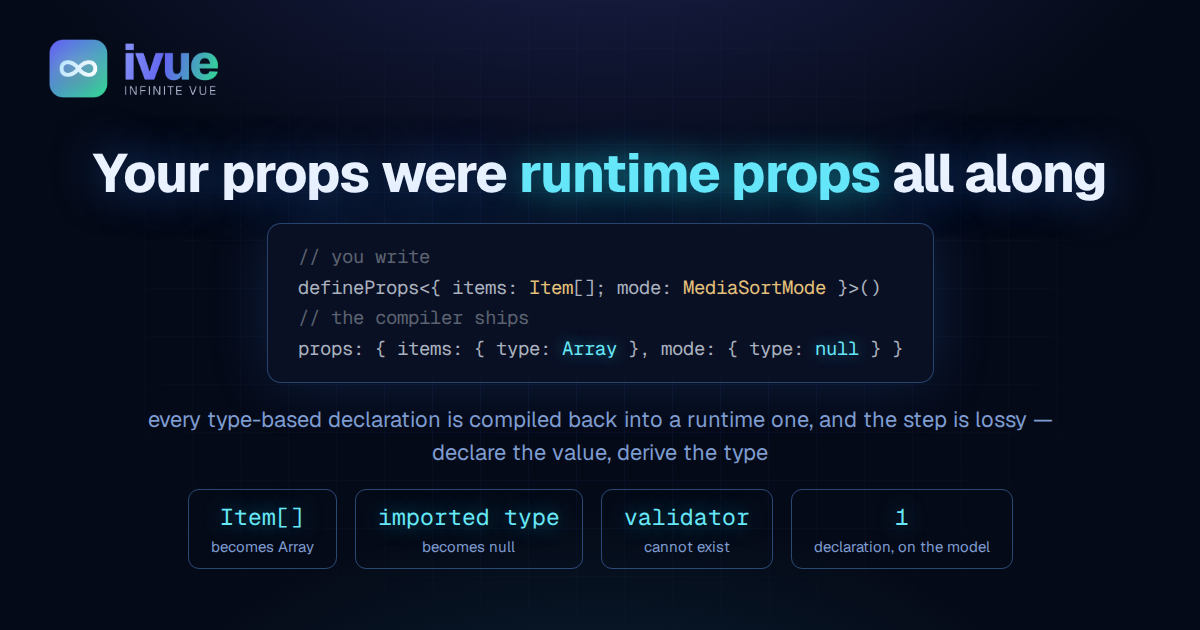
This is what you write:
defineProps<{ items: Item[]; mode: MediaSortMode }>();This is what ships:
props: { items: { type: Array, required: true }, mode: { type: null, required: true } }There is no type-based props system in Vue at runtime. There is one props system, the runtime one, and <script setup> puts a compiler in front of it that reads your type literal and writes the runtime declaration for you. The type was never the contract. It was a request for one, and the compiler fills in what it can.
Types describe a contract. Values keep it.
This post is about what the compiler loses in that step, why the loss is the whole reason to declare the runtime contract yourself, and where the contract belongs once you do.
What the compiler emits
Every line below was produced by running @vue/compiler-sfc 3.5 over a one-line <script setup lang="ts"> and reading the props object it emitted.
| you write | the compiler ships | what is gone |
|---|---|---|
width: number | { type: Number, required: true } | nothing |
size: number | string | { type: [Number, String] } | nothing |
size?: number with default 32 | { type: Number, default: 32 } | nothing |
items: Item[] | { type: Array } | the element type |
items: T[] in a generic component | { type: Array } | the element type |
mode: MediaSortMode imported from another file | { type: null } | the whole check |
The first three rows are the happy path, and they are the rows every tutorial shows. The last three are what happens to a real component. An array of anything is an array. A generic is an array. A type the compiler cannot see into becomes null, which is Vue's spelling of "accept anything", so a prop declared with your most carefully named domain type gets no runtime check at all.
Said plainly: the compiler turns your type into a checklist. When it cannot read the type, it writes "anything" on that line and moves on.
Two more things cannot survive the step because they were never in the type to begin with. A validator, the function that says a size must be positive, has no type-level spelling, so type-based props cannot declare one. And a default for an object or array prop must be a factory, which withDefaults handles by rewriting your literal into one. Both are runtime facts about the contract that the type-based form can only approximate.
Where the emitted object lives
The compiled props object is real. Import the component and it is sitting on the definition, and you can spread it into another component's runtime props. That is how Quasar shares a field contract across its inputs, with an object spread per component.
But look at what you are spreading. It is the post-erasure object. The Item[] is already an Array. The imported type is already null. The TypeScript side that made the declaration precise is gone, because it never lived in the same place as the value. So a contract shared this way is shared untyped, and a variant that extends it types itself by hand or not at all.
The type and the value were declared in one place and then stored in two, and only one of them can be reused.
That split is the actual problem. Not that types are bad, and not that runtime declarations are verbose. The problem is a contract whose typed half and whose checked half live in different worlds, so that anything that reads one cannot see the other.
Declare the value, derive the type
ivue, a 1.1 kB class layer over Vue's reactivity, puts the contract on the model class as static getters and derives the TypeScript type from the value. One declaration, two readers, nothing stored twice.
class $MediaField extends Field.$Class {
  static override get propsTypes() {
    return definePropTypes({
      ...super.propsTypes,
      items: { type: Array as PropType<MediaField.Item[]>, required: true },
      mode: { type: String as PropType<MediaField.SortMode>, default: 'newest' },
      size: { type: Number, default: 32, validator: (size: number) => size > 0 },
    });
  }
}

export namespace MediaField {
  export type Props = ExtractPropTypes<typeof $Class.props>;
}Read what each line kept that the compiler would have dropped. The array prop knows its element type, because PropType<Item[]> is carried on the value and ExtractPropTypes reads it back. The imported union is a String with the exact literal type attached, not null. The validator exists. The default is a value the class owns, not a literal a macro rewrote.
And the SFC does what an SFC should, which is wire:
<script setup lang="ts">
import { MediaField } from './MediaField';

const props = defineProps(MediaField.Class.props);
const emit = defineEmits(MediaField.Class.emits);

const media = new MediaField.Class(props, emit);
</script>defineProps with a runtime object is the form Vue always supported. It is not a fallback. It is the form the compiler was translating into the whole time, written once by hand where it can be typed, reused, and read.
What a contract-as-value can do
Once the contract is a value on a class, every reader you could want has it, and none of them needed a compiler.
- A variant extends it.
...super.propsTypesplus three keys. The compiler checks the override, and forty-five props arrive in the child without a spread. That was the previous post, with the receipts. - A test reads it.
ContactAvatar.Class.propsDefaults.sizeis32in a test with no component mounted. A type-based default is unreachable from outside the SFC. - A knobs panel reads it. The defaults are the panel's initial values and the types are its control kinds, straight off the class. Nothing that starts as a type can do this, because a type is gone before the panel runs.
- An agent reads it. A model that writes a variant imports the class and enumerates the contract as data. It does not parse a type literal out of a
.vuefile and guess. - A renderer swap does not touch it. The contract is on the class, not in a macro, so the same model runs under a template, a render function, or a Vapor template. Type-based props exist only inside the compiler pass that reads them.
None of these is a feature that was designed. Each is what happens when a contract is a value: values can be read.
Why Vue chose types, and where that stays right
Vue's choice was correct for the architecture Vue assumed. In <script setup> the component is the owner of its own contract. Nothing extends it, nothing else reads it, and the props are consumed by the template in the same file. Under that assumption the type literal is the shortest thing that works, and the lossy compile costs little because nobody downstream needed the lost information.
That assumption also marks the boundary of the standard. A markup-only leaf with one prop has no model, and type-based props are the right form for it. The moment a component owns state, derivation, or a handler, it has a model, the model owns the contract, and the contract is a value.
The cost
Runtime declarations are longer. Array as PropType<Item[]> is a cast a type literal never asks for, and a forty-prop contract is forty of them. Inside a generic component the cast is the only way to name T, so the compiler helps less there, not more.
That is the whole price. Against it: nothing erased, nothing declared twice, and a contract that four kinds of reader can use without asking the compiler for permission.
Types describe the contract. Values keep it.

Comments