
The stack got faster. We changed nothing.
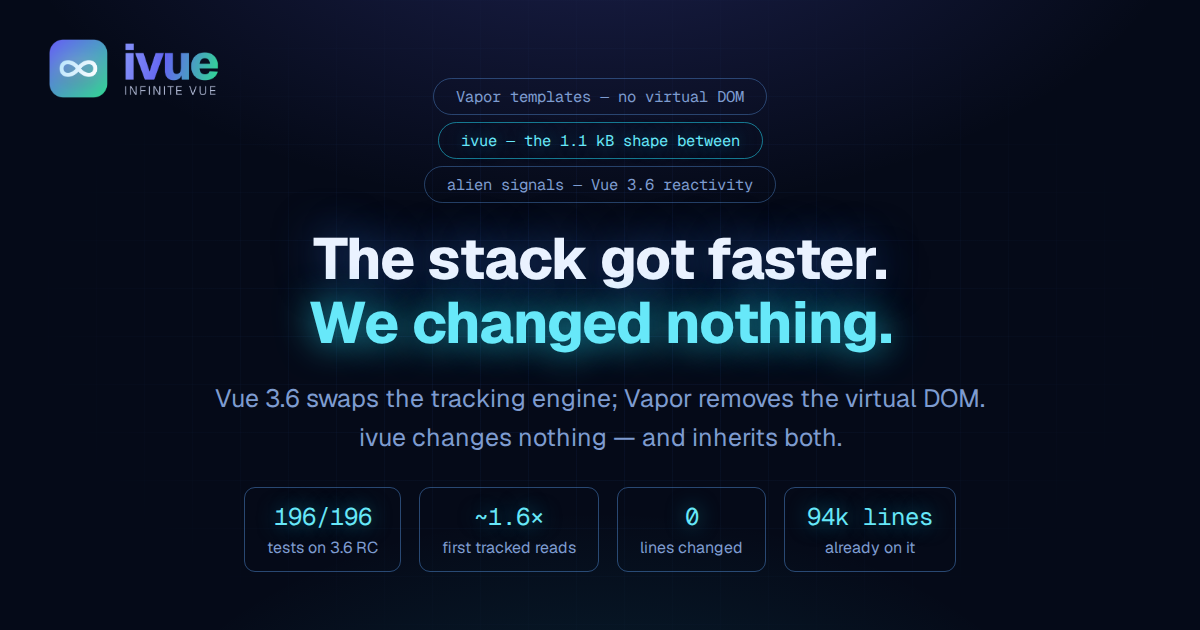
Vue 3.6 is in release candidate. Under its hood is the largest change the reactivity system has had since Vue 3 shipped: the tracking engine is rewritten on alien signals, the fastest signal implementation in the ecosystem's benchmarks. On the other side of the stack, Vapor mode compiles templates that update the DOM directly, with no virtual DOM between the data and the pixels.
Here is what ivue had to change to be ready for both:
Nothing.
The position, not the effort
That is not a boast about porting speed. It is a consequence of where ivue deliberately sits. The engine owns no reactivity of its own — no tracking, no scheduler, no signal graph. A class's state getters return Vue's own ref(); derivations track through Vue's own effect machinery; watch is Vue's watch. ivue is a shape over the substrate: one prototype transform that decides where state lives and when it materializes, and then gets out of the way.
Hold that position and substrate upgrades arrive as pure profit. When Vue swaps its tracking engine, every ivue class in existence is running on alien signals the moment the dependency updates — same code, same standard, same 1.1 kB.
The thinner the layer, the more of the platform's progress it inherits for free.
Measured on the release candidate
The full ivue test suite — 196 tests, 100% coverage — passes on vue@3.6.0-rc.5 without touching a line. Same machine, same script, production build, median of three runs (Node 26):
| operation | Vue 3.5.41 | Vue 3.6.0-rc.5 | change |
|---|---|---|---|
| create 100,000 instances | 3.9 ms | 3.9 ms | unchanged — creation never depended on tracking |
| first tracked read across all 100,000 | 20.6 ms | 13.2 ms | ~1.6× faster |
| 2,000,000 hot derived reads | 47.4 ms | 43.7 ms | ~8% faster |
| 100,000 writes through an effect | 8.6 ms | 8.4 ms | within noise |
The row that moves most is the one that matters most at scale: the first tracked read, where lazy cells materialize and dependencies register. That is exactly the path ivue leans on — nothing allocates until first touch, so the cost of a large instance population is the cost of first touches. Alien signals cuts more than a third off that cost; ivue's own creation row doesn't move because it was already nearly free, by design rather than by engine.
And this is not only a benchmark claim. Invar — 108,000 lines, 384 classes, a full terminal IDE — has been running its entire model layer on the 3.6 release candidate's reactivity in production, daily. Not because every corner of 3.6 is final, but because the reactivity core is the only part the backend consumes — and it holds.
No DOM required
That last point generalizes. Invar's process is a Bun backend with no DOM in sight: files, git, terminals, an editor's text model — all ivue classes, all tracked by Vue's signal graph, none of it rendering anything. Reactivity as a dependency engine for systems, not just views.
Which means the alien-signals upgrade is not a frontend story. Every backend running the standard inherits the same faster graph — the same week it lands, for the same effort: none.
Vapor, on the other side
Vapor mode attacks the other half of the stack: templates compile to direct DOM updates, no virtual DOM, no diffing. And the model layer's contract with the view is exactly the contract Vapor consumes — refs and getters, destructured once in setup, read by the template. Nothing in the standard touches the renderer, so the same class that drives a virtual-DOM component drives a Vapor one.
The stack is improving from both ends — signals below, rendering above — and the model layer between them stays one kilobyte, because it never claimed either end's job.
The bet, restated
Three years ago the bet was that a class layer should ride the platform's reactivity rather than own one. Every engine the substrate swaps in, every renderer the compiler removes, tests that bet again. So far the score is: zero migrations, zero shims, and speed that shows up in the benchmarks before we've done anything to deserve it.
The bench script is in the repository — rerun it on your machine when the RC goes stable. That's the standing invitation of this blog: measured, not promised.

Comments