
Bulletproof class modules
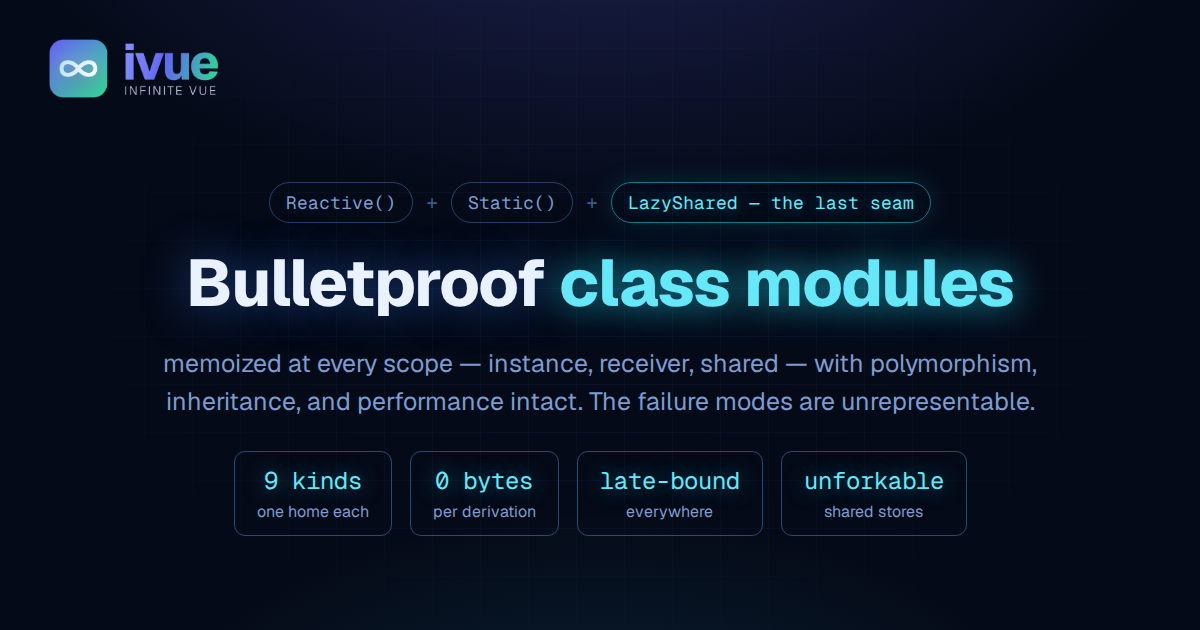
Every value a class module can hold wants three things at once: to be computed once (memoized at the right scope), to stay overridable (polymorphism and inheritance keep working), and to cost nothing it didn't earn (no allocation before first use, no tax after). JavaScript gives you no help reconciling the three — eager statics race module loading, per-instance caching bloats objects, and anything cached too early stops respecting subclasses.
ivue's architecture has been closing that triangle one seam at a time. With LazyShared, the last seam is sealed: the combined Reactive() + Static() system now memoizes at every scope a value can live in, without giving up late binding anywhere. This post walks the whole map — every value kind, in code.
Bulletproof does not mean "carefully avoided." It means the failure modes are unrepresentable: there is no way to write the forked registry, the load-order race, or the stale
this— each value kind has exactly one home, and every home is safe by construction.
The ivue full transform map
| the value is… | use a | memoized | inheritance |
|---|---|---|---|
| mutable state | ref-getter | per instance, on first touch | subclass overrides the getter |
| a derivation | plain getter | never allocated — prototype only | super works; zero bytes to inherit |
| an expensive derivation | computed() thin closure | per instance | body delegates to an overridable method |
| a store or composable | instance $-getter | per instance, forever | resolves at first touch, after cycles |
| a method | plain method | bound lazily, per receiver | stable identity, safe to detach |
| a tunable static | live static getter | never — deliberately fresh | the override IS the feature |
| a static memo | $-static getter | per receiver | subclass derives through its overrides |
| a shared registry | static readonly field | one reference | inherited, never receiver-cached |
| shared AND constructed | LazyShared cell | one value, built on first read | every receiver converges on it |
Nine value kinds, nine homes, no judgment calls left at the call site. The rest of this post is the map, executed.
The instance scope — Reactive()
The first five rows live on one class. Everything here is lazy — an instance is a plain object at construction, and each member materializes only when something reads it:
// cart.ts
import { Reactive } from 'ivue';
import { ref, shallowRef, computed } from 'vue';
import { useSessionStore } from './session.store';

class $Cart {
  // MUTABLE STATE — ref-getters. The Ref allocates on FIRST TOUCH and
  // is cached per instance from then on; an untouched member costs
  // nothing. Read and write via .value.
  get items() {
    return shallowRef<CartItem[]>([]);
  }
  get couponCode() {
    return ref('');
  }

  // DERIVATION — a PLAIN getter. Never allocated: it lives on the
  // prototype, costs zero bytes per instance, and is reactive through
  // the leaves it reads. This is the workhorse — in ivue's own admin
  // dashboard, ~170 of these do all derivation with zero computed().
  get subtotal() {
    return this.items.value.reduce(
      (sum, item) => sum + item.price * item.quantity,
      0,
    );
  }
  get isEmpty() {
    return this.items.value.length === 0;
  }

  // EXPENSIVE DERIVATION — computed(), the surgical opt-in (~300
  // bytes/instance buys value-caching between dependency changes).
  // The closure is THIN: it only dials a method, so the logic stays
  // on the prototype — testable directly, overridable by subclasses.
  get sortedItems() {
    return computed(() => this.sortItems());
  }

  // STORE / COMPOSABLE — the `$`-getter caches WHOLE, per instance,
  // forever. It runs on first touch — long after every module in any
  // import cycle has loaded — which is why circular imports are a
  // non-event in this architecture.
  private get $session() {
    return useSessionStore();
  }
  get discount() {
    return this.$session.memberDiscount;
  }

  // METHODS — plain. The engine binds each one lazily, once, on first
  // access, with stable identity: safe to detach, pass to listeners,
  // and compare. You pay one bind per method you actually use.
  addItem(item: CartItem) {
    this.items.value = [...this.items.value, item];
  }

  sortItems() {
    return [...this.items.value].sort(byPrice);
  }
}

export namespace Cart {
  export const $Class = $Cart; // raw — children `extends` this
  export let Class = Reactive($Class); // reactive — you `new` this
  export type Instance = typeof Class.Instance; // defineExpose type & reactive() interop
}Inheritance is not a special case at this scope, because derivations are getters — real language members that understand extends and super:
// wholesale-cart.ts
import { Reactive } from 'ivue';
import { Cart } from './cart';

class $WholesaleCart extends Cart.$Class {
  // override ONE derivation; every other member is inherited at zero
  // bytes — the prototype chain IS the reuse mechanism
  get subtotal() {
    return super.subtotal * this.wholesaleFactor;
  }

  wholesaleFactor = 0.8;
}

export namespace WholesaleCart {
  export const $Class = $WholesaleCart;
  export let Class = Reactive($Class);
  export type Instance = typeof Class.Instance;
}The receiver scope — Static()
Rows six and seven belong to capability classes — function bags for git, files, parsers, clocks: never constructed, only called and swapped. Static() (from ivue/extras) gives their statics the same two properties instances enjoy: lazily bound methods with stable identity, and $-prefixed getters that compute once per receiver:
// git-commands.ts
import { Static } from 'ivue/extras';

class $GitCommands {
  // TUNABLE STATIC — a LIVE getter, no $ prefix: never cached, so a
  // subclass or test double overrides it and everything derived from
  // it follows
  static get binary() {
    return 'git';
  }

  // STATIC MEMO — the $ prefix makes this compute once PER RECEIVER.
  // The base class derives one environment; a subclass that overrides
  // `binary` derives its OWN through the override. Forking on
  // subclass is the feature here.
  static get $environment() {
    return { GIT: this.binary, LC_ALL: 'C' };
  }

  // METHOD — bound lazily to the RECEIVING class; detachable, stable
  static stage(path: string) {
    return this.run([this.binary, 'add', '--', path]);
  }
}

export namespace GitCommands {
  export const $Class = Static($GitCommands); // anchor — children `extends` this
  export let Class = $Class; // selection — kernels/tests swap this
}Polymorphism at this scope is receiver polymorphism, and the memo respects it:
class $SandboxGit extends GitCommands.$Class {
  static get binary() {
    return '/sandbox/bin/git'; // override the knob…
  }
}

// …and the per-receiver cache derives THROUGH the override:
$SandboxGit.$environment.GIT; // '/sandbox/bin/git'
GitCommands.Class.$environment.GIT; // 'git' — each receiver, its own memoReading your own statics — self
Instance code reading its class's statics crosses JavaScript's least ergonomic boundary: instance members and static members live on two parallel inheritance chains that never touch, and the only runtime bridge — this.constructor — is typed as bare Function. The standard is one cast per class, named self, and direct reads at every call site:
class $Tooltip {
  static get TOOLTIP_DWELL_SECONDS() {
    return 0.4; // stays overridable — subclasses and tests change it
  }

  protected get self() {
    return this.constructor as typeof $Tooltip;
  }

  show() {
    this.dwellTimer.start(this.self.TOOLTIP_DWELL_SECONDS);
  }
}this.constructor is the actual class, so the read is late-bound: a subclass setting 0.1 is honored everywhere, including inside $-caches computed from it. In hot paths the same hoisting discipline that governs refs and methods applies — and refunds more than it costs:
recalculate() {
  const self = this.self; // one read; the engine treats the class as
  for (const row of this.rows.value) {
    // a loop constant from here — measured ~0.4 ns/iteration,
    // CHEAPER than an inline cast per read (~4 ns)
    row.height = self.ROW_HEIGHT * self.DENSITY_FACTOR;
  }
}The shared scope — where it used to break
Rows eight and nine are the seam this architecture just sealed. A shared store — a registry, a ledger, one-per-process by contract — breaks BOTH earlier tools, each in its own way.
Break one: the per-receiver cache forks it.
class $CommandRegistry {
  // ❌ looks like a cache, behaves like a fork bomb
  static get $commands() {
    return new Map<string, Command>();
  }

  static register(name: string, command: Command) {
    this.$commands.set(name, command);
  }
}

// the base registers ten commands…
CommandRegistry.Class.register('open', openCommand);

// …and a subclass — a test double, a kernel variant — sees NONE of
// them: its first read of $commands derived a fresh, empty Map
class $TestRegistry extends CommandRegistry.$Class {}
$TestRegistry.$commands.size; // 0. Nothing throws. Nothing warns.The failure is silent, load-order-dependent, and surfaces far from the declaration that caused it.
The fix is a static field — one reference on the declaring class, inherited through the prototype chain, never receiver-cached:
class $CommandRegistry {
  protected static readonly sharedCommands = new Map<string, Command>();

  static get $commands() {
    return this.sharedCommands; // the field IS the pin
  }
}

class $TestRegistry extends CommandRegistry.$Class {}
$TestRegistry.$commands === CommandRegistry.Class.$commands; // trueBreak two: the field races module load. A field initializer runs while modules are still loading. A bare new Map() is safe — it depends on nothing. But the moment the initializer constructs another module's class, the load-order dragon is back:
class $SearchRegistry {
  // ❌ runs at module load — SearchBackend's module may not have
  // finished loading; in an import cycle this is a coin flip
  protected static readonly sharedBackend = new SearchBackend.Class();
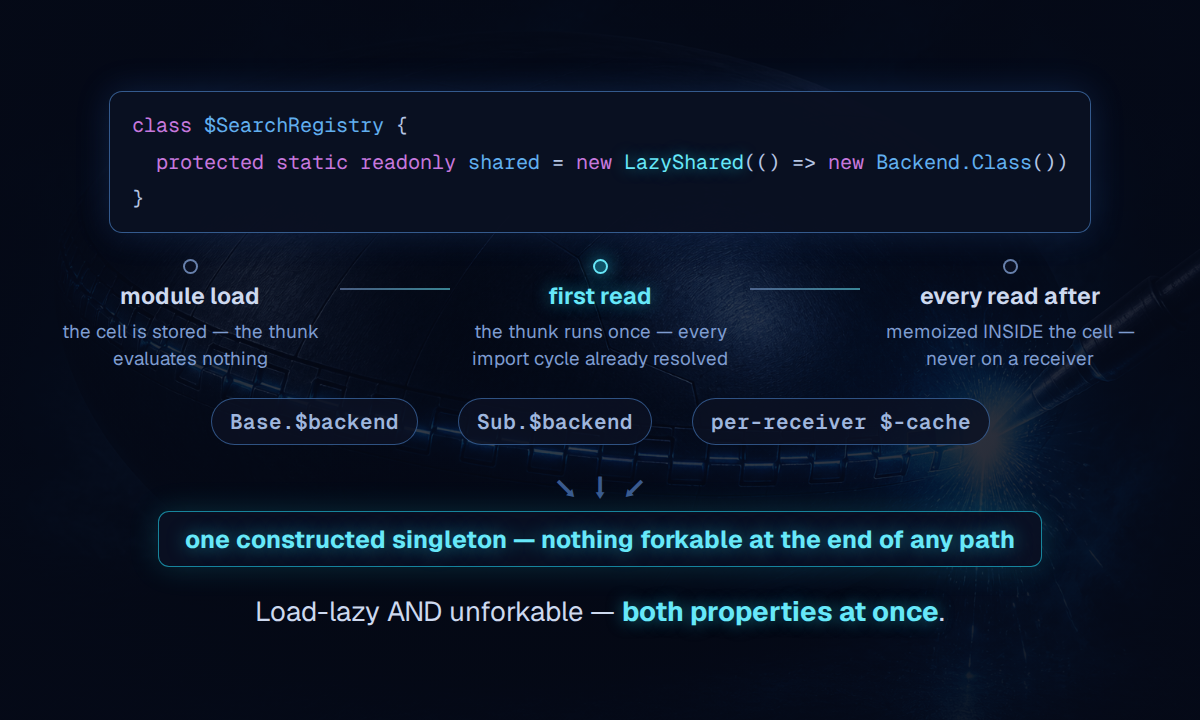
}The instance world solves exactly this with $-getters that defer to first touch. The static world can't — its $-getter forks. The seam needs both properties at once: load-lazy and unforkable.
LazyShared — the last seam
That two-property specification is the entire design. The implementation is small enough to print — this is the real source, from ivue/extras:
export class LazyShared<T> {
  constructor(private readonly make: () => T) {}

  private constructed = false;
  private constructing = false;
  private stored: T | null = null;

  get value(): T {
    if (!this.constructed) {
      if (this.constructing) {
        throw new Error(
          'LazyShared thunk cycle: this cell is read inside its own ' +
            'construction. Break the dependency between the two thunks.',
        );
      }
      this.constructing = true;
      try {
        this.stored = this.make();
        this.constructed = true;
      } finally {
        this.constructing = false;
      }
    }
    return this.stored as T;
  }

  /** Drop the constructed value; the next read constructs again. */
  reset(): void {
    this.constructed = false;
    this.stored = null;
  }
}Usage is the static-field form with the cell in the field:
import { LazyShared } from 'ivue/extras';

class $SearchRegistry {
  protected static readonly sharedBackend = new LazyShared(
    () => new SearchBackend.Class(),
  );

  protected static get $backend() {
    return this.sharedBackend.value;
  }
}Each step is safe on its own terms. Storing the cell eagerly is safe — a thunk evaluates nothing at load; the field holds a closure and two flags. Running the thunk on first read is safe — by then every module in every import cycle has finished loading, so it may freely construct other namespaces' classes. And sharing is safe because the memoized value lives inside the cell, never on a receiving class.
The cell is engine-agnostic — it seals the shared scope for BOTH transforms. A Static() capability class uses it as above; a class that carries reactive instances and statics composes the transforms and gets the same guarantee on its static side:
// settings.ts — reactive instances AND a sealed shared static
import { Reactive } from 'ivue';
import { Static, LazyShared } from 'ivue/extras';
import { ref } from 'vue';

class $Settings {
  protected static readonly sharedStorage = new LazyShared(
    () => new StorageBackend.Class(),
  );
  protected static get $storage() {
    return this.sharedStorage.value; // one backend, every receiver
  }

  // …while instances stay fully reactive
  get theme() {
    return ref<'light' | 'dark'>('dark');
  }

  persist() {
    this.self.$storage.save('theme', this.theme.value);
  }

  protected get self() {
    return this.constructor as typeof $Settings;
  }
}

export namespace Settings {
  export const $Class = Static($Settings); // anchor the statics…
  export let Class = Reactive($Class); // …then the instance transform
  export type Instance = typeof Class.Instance;
}One class, all nine rows available at once — reactive state on the instances, per-receiver memos and the sealed shared store on the statics, self bridging the two chains.
That last property is the one that seals the seam: forking the access path is harmless, because there is nothing forkable at the end of it. This is test-proven in ivue's suite — subclass receivers, and even per-receiver $-caches layered over the cell, converge on the one singleton:
let constructionCount = 0;

class $Registry {
  protected static readonly sharedEntries = new LazyShared(() => {
    constructionCount += 1;
    return new Map<string, number>();
  });
  static get $entries() {
    return this.sharedEntries.value; // a per-receiver cache… of the ONE value
  }
}
const Registry = Static($Registry);
class $SubRegistry extends Registry {}
const SubRegistry = Static($SubRegistry);

Registry.$entries.set('planted', 7);
SubRegistry.$entries === Registry.$entries; // true
SubRegistry.$entries.get('planted'); // 7
constructionCount; // 1 — one construction, everEven failure is engineered rather than left to chance:
// a cycle between cells is a NAMED, retryable error — not a stack overflow
const cellA = new LazyShared((): number => cellB.value + 1);
const cellB = new LazyShared((): number => cellA.value + 1);
cellA.value; // throws: 'LazyShared thunk cycle: …'

// and a throwing thunk never poisons the cell — the next read retries
let attempts = 0;
const cell = new LazyShared(() => {
  attempts += 1;
  if (attempts === 1) throw new Error('backend not ready');
  return 'ready';
});
try { cell.value; } catch {} // first read: the real error, surfaced
cell.value; // 'ready' — construction retried, then memoizedreset() completes the story as the test seam: a spec that needs a fresh shared store resets the cell instead of reaching into module state.
What was never given up
Polymorphism. Every memo in the map is late-bound to its receiver: $-statics derive through subclass overrides, methods bind to the receiving class, self reads resolve to the actual constructor. The one value that must NOT respect the receiver — the shared store — is exactly the one whose state lives outside receiver-space. The rule and its exception are the same principle read in both directions.
Inheritance. Derivations are getters, so extends and super work on them. Statics anchor once at $Class and children extend it bare — a subclass overriding one knob inherits working caches, bound methods, and the shared stores, with no re-wrapping. Nothing in the memoization layer treats a subclass as a special case.
Performance. Memoization here is not a cache bolted on — it is the allocation model. Instances are plain objects; derivations cost zero bytes each; nothing computes before first use, which is why creating 100,000 instances measures 55–253× faster than the alternatives (Performance by Design). The residual taxes are measured, and each has a one-line refund — hoist the $-cache read, hoist const self = this.self — landing at fractions of a nanosecond per iteration, cheaper than the unhoisted "fast" form.
Why this matters beyond ivue
The triangle — memoized, overridable, pay-per-use — is not an ivue problem. It is what every module system with classes eventually fights: singletons that break under subclassing, initializers that break under circular imports, caches that break polymorphism. The usual answer is discipline — conventions, lint rules, review vigilance.
The architecture's answer is structural. Each value kind gets a home whose guarantees are enforced by the engine or by the shape itself, and the homes compose — which is why the whole map fits in one table and the newest piece is forty lines. Discipline you maintain; structure you inherit.
The reference lives in the guide: Caches, Registries & self — and the system it completes is The Standard.

Comments