
Props inherit now
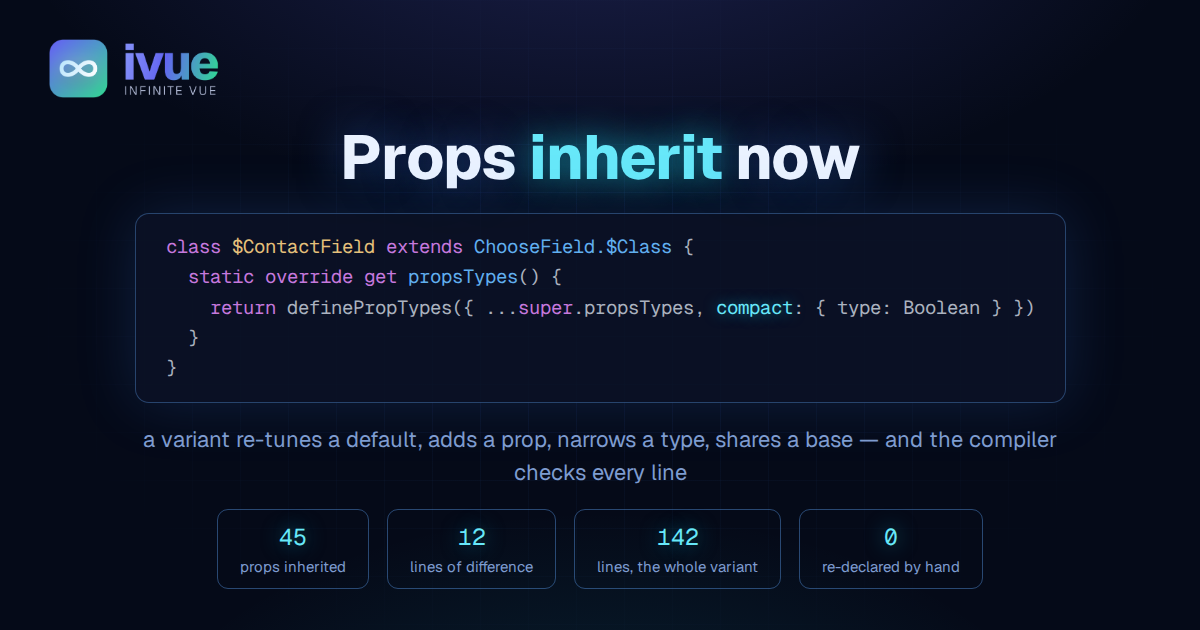
Classes extend. State, derived values, methods: a child class overrides any of them with super in reach, and the compiler checks the override. Props never did. In every Vue component ever written, the contract was the one part of the component that could not inherit.
The usual shape is a withDefaults(defineProps<T>()) macro. The types are a compile-time interface. The defaults are locked inside a compiler transform. Neither is a value another file can import, spread, or override three keys of. So a variant of a forty-prop component re-declares forty props by hand, or falls through to untyped $attrs and hopes. Either way the parent and the variant have two contracts that nothing keeps in step.
Props were the last part of a component that could not inherit.
In ivue the contract is three static getters on the class, and a child class extends it the way it extends behavior. This post is about what that buys, with the code that shipped.
The four moves
Every extensible contract is one of four moves on a base. All four are live in the playground fields.
Re-tune. The horizontal scroller inherits every prop of the vertical one and changes one number. One override, and nothing else to write:
class $HorizontalVirtualScroller<T extends VirtualScroller.BaseItem> extends VirtualScroller.$Class<T> {
  static override get propsDefaults(): typeof VirtualScroller.$Class.propsDefaults {
    return {
      ...super.propsDefaults,
      assumedSize: 300 // cards are hundreds of px wide; rows were tens tall
    };
  }
}Add. The contact field is the choose field preconfigured for people. It adds one prop of its own and re-tunes eleven inherited defaults: chips on, server search and pagination on, contact-shaped label and description priorities. Forty-five inherited props, twelve lines of difference, and the whole class file is 142 lines:
class $ContactField extends ChooseField.$Class {
  static override get propsTypes() {
    return definePropTypes({
      ...super.propsTypes,
      /** Compact display mode: smaller avatar, name only, denser rows. */
      compact: { type: Boolean as PropType<boolean> },
    });
  }

  static override get propsDefaults(): ExtractPropDefaultTypes<typeof $ContactField.propsTypes> {
    return {
      ...super.propsDefaults,
      useChips: true,
      roundChips: true,
      fetchSearch: true,
      fetchPagination: true,
      fetchRowsPerPage: 8,
      optionLabelPriority: ['name', 'email', 'id'],
      compact: false,
    };
  }

  static override get props() {
    return propsWithDefaults(this.propsDefaults, this.propsTypes);
  }
}Narrow. The media uploader inherits the field base's modelValue, typed any there because every field models something different, and narrows it to what a media field can hold. Same key, tighter type, one line:
static override get propsTypes() {
  return definePropTypes({
    ...super.propsTypes,
    /** Narrowed from the base's `any`: rows, ids, a mix, or null. */
    modelValue: { type: [Object, Array, String] as PropType<MediaField.Model> },
    // …the eleven media-specific params
  });
}Share. The nine props every field passes through to Quasar's QField (model, label, hint, density, the disabled and readonly states, loading, outlined, and the runner) are declared once, on a Field base class. The choose field and the media uploader extend it and never mention them. A shared surface is a base class, not a constant spread into each contract.
| class | inherits | adds | re-tunes |
|---|---|---|---|
Field | 0 | 9 | 0 |
ChooseField | 9 | 36 | 0 |
ContactField | 45 | 1 | 11 |
MediaField | 9 | 11 | 1 (narrows modelValue) |
The plain version: a child says only what is different, and the compiler checks that it still fits.
What the compiler checks
Extension is only worth having if it cannot drift. Four small pieces of machinery make each move safe, and each one is a compile error, not a convention.
- A prop without a default is an error. The defaults getter is annotated
ExtractPropDefaultTypes<typeof $X.propsTypes>, which requires every optional prop to appear. Addcompactto the types and forget its default: the file does not compile. Required props are filtered out of the check, and a deliberately default-free prop is declaredkey: undefined, a decision stated in data. required: truesurvives.definePropTypes()is an identity call whose only job is generic inference. A bare object literal widensrequired: truetoboolean, which would blind the defaults check.- The base surface is never mutated. Spreading a types map shares the inner descriptor objects.
propsWithDefaultscopies each one before applying a child's defaults, so re-tuning a default in a child cannot rewrite the parent's. - Every override says so.
noImplicitOverrideis on. Rename a prop in the base and every child that re-tunes it fails to compile at the exact line. The class hierarchy and the contract hierarchy are the same hierarchy.
And the resolved TypeScript type is never written by hand. ContactField.Props is ExtractPropTypes<typeof $Class.props>, so the one thing a child has to remember when it adds a prop is to re-declare the fusion line, because a static's return type is not polymorphic. A child that only re-tunes does not even do that.
Runtime props, and what type-based props gave up
Vue chose type-based props. defineProps<Props>() reads an interface, and the compiler turns it into a runtime declaration for you. It is concise, and for a terminal component it is the right call. It also gives up four things, all of them at once:
- The contract is not a value. An interface cannot be imported at runtime, spread, inspected, or handed to a function. Nothing outside the compiler can see what a component accepts.
- Defaults are not a value either.
withDefaults()locks them in a transform. A variant cannot read the parent's defaults, so it cannot re-tune one. Object and array defaults need hand-written factories. - Cross-file types are a compiler problem. The macro has to resolve
Propsacross imports at build time, with rules about what shapes it can follow. A runtime object never asks the compiler to do that. - Nothing is checkable at runtime. Types erase. A tool that wants to verify a contract, render one, or compare two has nothing to read.
Runtime props keep all four, and lose nothing on the type side, because the types are derived from the values instead of the other way round. ExtractPropTypes<typeof $Class.props> is the resolved contract as the class receives it, with defaulted props non-optional. And the defaults are extractable on their own: typeof $ContactField.propsDefaults is a type, and ExtractPropDefaultTypes<typeof $ContactField.propsTypes> is the check that every optional prop has one. A test asserts a default. A docs page renders a props table from the object the component actually uses, never a copy. A gate diffs two contracts.
The use that matters most is an interface built ON the defaults. A property panel, a design tool, an agent harness that lets a person or a model tune a live component: each needs every knob shown with its initial value already in place. X.Class.propsDefaults is that panel's data, read at runtime from the component itself, so thumbnailSize opens at 132 and fetchRowsPerPage at 8 without anyone copying a number out of the source. A subclass's panel shows the subclass's defaults, because the getter reads through the receiver. Type-based props cannot do this at all: the defaults exist only inside a compiler transform, and at runtime there is nothing left to read. The shell can compare an arriving runner's Class.props against the declared set at mount and warn on a mismatch, a tripwire type-based props cannot offer because there is nothing there to compare.
The compiler still does its job. It does it on data you own.
What it makes possible
A component becomes a family. One choose field, and a contact field, a country field, a tag field, each a page of differences over one implementation. Nothing about that is new in class design. What is new is that the family's props are part of the inheritance, so the variants stay typed and stay in step. The ContactField file is 142 lines because the other 858 are inherited, contract included.
A variant is a diff. When an AI agent generates a variant, the output is a subclass whose contract states its deltas. A reviewer reads twelve lines and sees exactly what changed. A gate can check the shape. That is the property that let agents build a 108,000-line editor on this standard without the components drifting apart: the diff is the format, and the compiler holds the base still.
Test doubles re-tune, not mock. A test subclass overrides one default or one tuning knob and the rest of the contract comes along. No fixture that re-declares a surface it does not care about.
The contract swaps with the runner. The SFC reads X.Class.props, and Class is a mutable slot. Reassign it and the component's inputs move with its logic, in one place. Before, the contract was a const beside the class and only half of the component moved.
Extension has direction. A child can widen (add), narrow (a tighter type), or re-tune. It cannot silently remove, because the base type flows through super. That asymmetry is the same one that makes subclassing safe for behavior: a consumer written against the base keeps working against every child.
The cost
Two lines a child pays that a namespace const did not: the override keyword, and the re-declared fusion line when a child adds props. Both are the compiler seeing the seam. There is no runtime cost. The getter reads happen once, when the SFC is defined, and the engine underneath is still 1.1 kB.
Vue 3 only, and only for components written as ivue classes. A plain withDefaults component stays what it is.
Where the line ends
Ask what a component is: markup, state, derivation, behavior, contract. Four of those extended by inheritance for as long as ivue has existed. The contract was the holdout, carried as data beside the class, spread by hand, checked by nobody. Moving it onto the class did not add a feature. It removed an exception.
Props inherit now. Nothing on a component is left that does not.

Comments